ActiveCampaign or Mailchimp – which one actually makes you more money?
That’s the only question that really matters.
Because both platforms can send emails. Both look good on the surface. But when it comes to automation, conversions, and scaling your business… the differences are huge.
In this guide, I’ll break down exactly where each tool wins (and loses), so you can choose the one that gives you the best return in 2026.
Let’s dive in.
ActiveCampaign vs. Mailchimp – My Recommendation for Long-Term Success (Quick Summary)
If you just want the short answer, here it is:
For anyone building a serious, long-term business, my recommendation is ActiveCampaign.
We reached this verdict by looking at how these two tools have drifted apart.
Here is the main reason:
Mailchimp still works well as an all-in-one starting point for beginners and small businesses that want to send simple newsletters. ActiveCampaign, on the other hand, now calls itself an “Autonomous Marketing” platform and has pushed deeper into that direction. It has also introduced Claude integration, becoming the first platform in this category to do so.
The primary shift in 2026 is ActiveCampaign’s move toward AI Agents that handle the entire marketing lifecycle, whereas Mailchimp focuses on “Intuit Assist” for guided, manual creation.
So, in short, if you’re just starting out, Mailchimp might do the job. But as your business grows, tools like ActiveCampaign tend to deliver stronger results through better automation, segmentation, and personalization.
-> Sign up for a free 14-day trial of ActiveCampaign (no credit card required) ->
(See results in 30 days or get your money back).
Considering switching from Mailchimp? Here’s what you need to know.
Our Overall Ratings:
| ActiveCampaign | Mailchimp |
| ★★★★★ 5 out of 5 | ★★★★ 4.8 out of 5 |
Still unsure? Here’s the simple way to decide:
- Choose Mailchimp if you just want to send simple emails without a lot of setup.
- Choose ActiveCampaign if you need powerful automation and a CRM to scale your business.
If you’ve made your choice, great. Now let’s move into a side-by-side comparison and see which platform performs better in each category.
At-a-Glance Comparison Table
Here’s a simple overview of how both platforms stack up across the key areas:
| Feature | ActiveCampaign | Mailchimp |
| Core Strength | Granular, behaviour-driven campaigns. | Quick-start, polished emails. |
| Automation Depth | Multi-step, cross-channel workflows with conditional logic. | Basic triggers and early-stage marketing automation flows. |
| Segmentation | Event-driven, dynamic personalization at the contact level. | List-based with a focus on broad demographics. |
| Personalization | Easy | Easy |
| Sales Tools | Full, built-in CRM with deal pipelines and lead scoring. | Audience management tools, but no true CRM. |
| Customization | Advanced | Good |
| Email and Landing Page Templates | 250+ (conversion-optimized templates). | 100+ (mostly simple). |
| Form Builder | Offers inline, pop-up, and floating forms easily. | Simple drag-and-drop, but styling options are rigid. |
| Deliverability | Hits the inbox 94% of the time on average (1st ranked). | Sits around 90-92% for most users (3rd ranked). |
| List Management | One main list where you use tags to group people. | Separated lists that don’t talk to each other. |
| Reporting and Analytics | Deep data on sales, automations, and revenue. | Simple stats on opens, clicks, and basic growth. |
| Dedicated IPs | – Available as a paid add-on – $750 (One-time fee) | – Available as a paid add-on – $29.95 (Monthly fee) |
| AI Features | – End-to-end campaign creation – Workflow suggestions – AI Brand Kit – Predictive Sending – Multilingual translation – AI Reporting Insights | – Content suggestions – Predictive insights – Auto-translate (forms & responses) |
| Ease of Use | Powerful system with an intuitive design for complex flows. AI reduces complexity. | Simple and easy-to-use tool, but limited. Manual effort grows with sophistication. |
| Support Model | Free migration and onboarding, with multi-channel support via: – Chat – Dedicated team (Enterprise) | Tier-based support access, only available for paid plans. |
| Integrations | 1000+ native integrations | 300+ native integrations |
| Pricing | Free 14-day trial available (no credit card required). Plans start at $19/month for 1000 contacts. Pay for advanced tools only when you need them. | Free tier available. Plans start at $16.14/month for 1000 contacts. Limited access to essentials on lower-tier plans. |
| Reputation | G2: 4.4/5 | G2: 4.3/5 |
| Links | Visit Website | Visit Website |
You’ve seen the comparison at a glance. Now let’s take a step back and get a quick introduction to each platform.
What is ActiveCampaign?
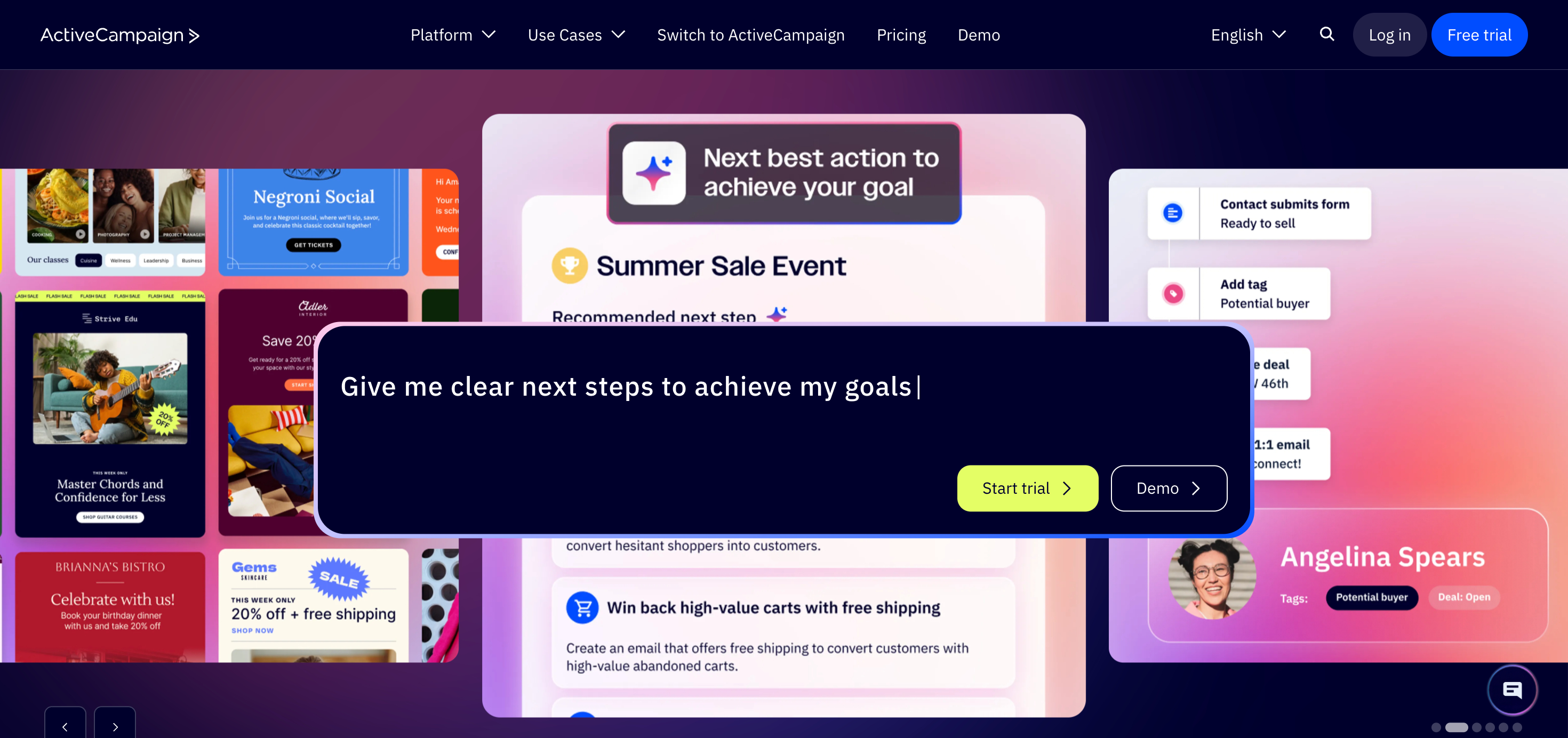
ActiveCampaign is an all-in-one marketing automation platform built to help businesses manage their customer experience through email marketing, automation, and a built-in Customer Relationship Management (CRM) system.
It is best known for its visual automation builder, which allows users to create complex, logic-based workflows that react to customer behaviours (like opening an email, visiting a specific webpage, or making a purchase) in real time.
Company Background
ActiveCampaign was founded in 2003 by Jason VandeBoom in Chicago. It originally started as a consulting firm and an on-premises software provider.
By early 2026, the company serves over 185,000 customers across 170 countries and maintains global hubs in cities like Dublin, Florianópolis, and Kraków.
Pros
- Best-in-Class Automation: The visual automation builder is widely considered one of the most powerful on the market. It allows you to create complex, behaviour-driven workflows using over 135 triggers and actions.
- High Deliverability: It consistently ranks among the top providers for ensuring emails actually land in the inbox rather than the spam folder.
- Integrated CRM: Unlike many competitors, ActiveCampaign includes a Sales CRM that allows you to automate lead scoring and track deals through a visual pipeline.
- Extensive Integrations: With over 1000+ native integrations, it connects seamlessly with popular tools like Shopify, WordPress, Salesforce, and Zapier.
- Machine Learning Features: Higher-tier plans offer Predictive Sending and Predictive Content, which use AI to determine the best time to send an email and what content will most likely convert.
- Free Migrations: They offer a complimentary service to help move your existing contacts, templates, and automations from another platform.
- Detailed Reporting: Offers deep insights into campaign performance, including click-maps, geo-tracking, and page visits.
Cons
- No Free Plan: Unlike competitors like Mailchimp or MailerLite, ActiveCampaign only offers a 14-day free trial. Paid plans typically start around $15–$19/month.
- Pricing Scales Quickly: Costs can rise quickly as your contact list grows. Additionally, many powerful features (like lead scoring and advanced CRM) are locked behind higher-tier plans.
What is Mailchimp?
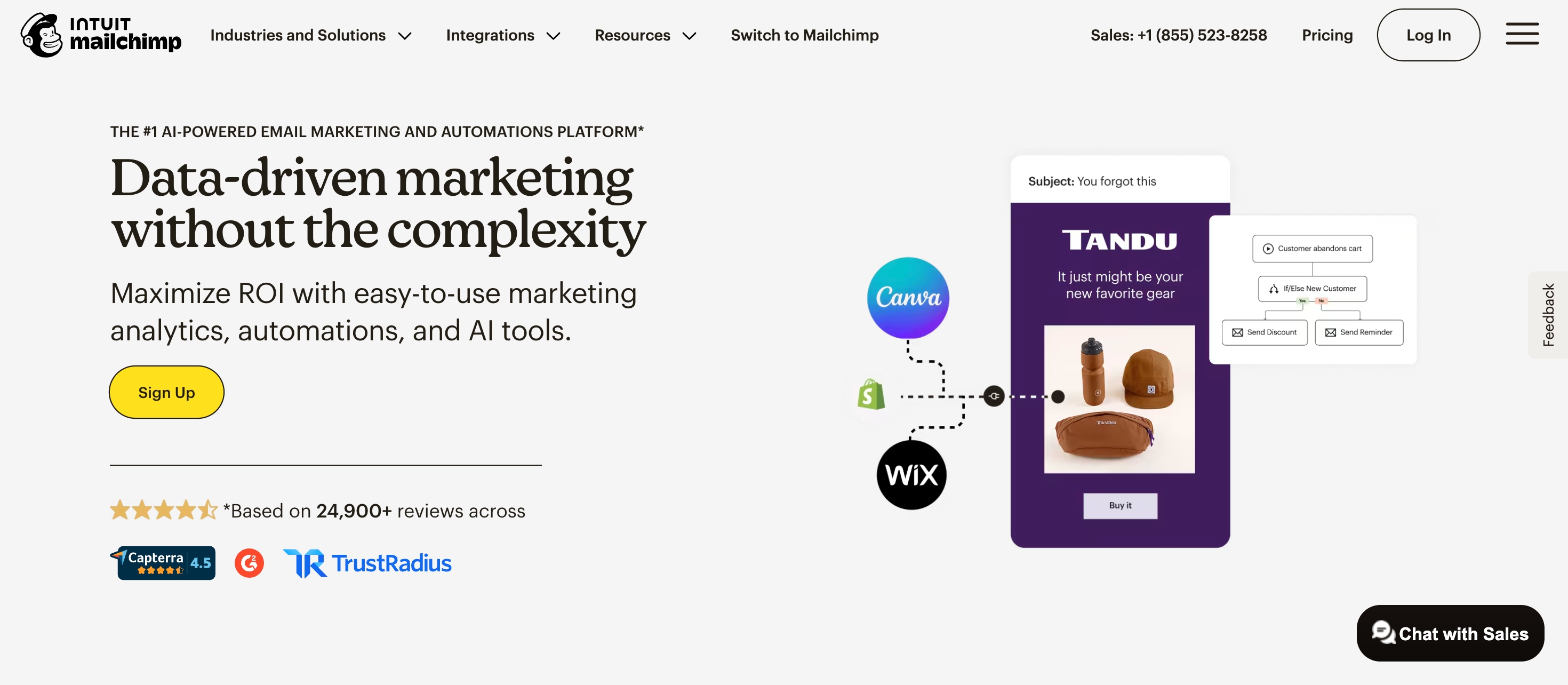
Mailchimp is an all-in-one marketing platform primarily known for its email marketing services.
Since its acquisition by Intuit in 2021, it has evolved from a simple newsletter tool into a comprehensive suite that includes CRM features, landing pages, and AI-powered automation.
Company Background
Mailchimp was founded in 2001 in Atlanta, Georgia, by Ben Chestnut and Dan Kurzius (along with Mark Armstrong). It originally started as a side project within their web design agency, The Rocket Science Group, intended to help small business clients with email marketing.
Pros
- User-Friendly Interface: Its drag-and-drop editor remains one of the most intuitive on the market, so beginners can build professional-looking emails without any hassle.
- Deep Integrations: With over 300+ third-party integrations (including Shopify, WordPress, and QuickBooks), it fits seamlessly into most existing business tech stacks.
- AI-Powered Content Tools: The new “Write with AI” and “AI Subject Line Generator” features help users draft copy and optimize engagement based on brand voice and historical data.
- Analytics: Mailchimp provides detailed reporting on open rates, click-through rates, and “predictive segmentation,” which uses AI to guess which customers are most likely to buy again.
- Multi-Channel Marketing: Beyond email, you can manage SMS marketing, social media ads, and postcards from a single dashboard.
Cons
- Expensive Scaling: Pricing increases sharply as your contact list grows. Many competitors (like MailerLite or Brevo) offer similar features at a much lower price for larger lists.
- Charging for “Inactive” Contacts: Unlike many other providers, Mailchimp counts unsubscribed and duplicate contacts toward your billing limit. If you don’t aggressively clean your list, you may end up paying for people you can’t even email.
- Very Limited Free Plan: In January 2026, the free plan was further reduced to just 250 contacts and 500 emails per month.
- Automation Gating: Advanced multi-step automations and “Customer Journey” builders are locked behind the Standard ($20+/mo) and Premium ($350+/mo) tiers.
- Limited Support on Lower Tiers: Free users only get email support for the first 30 days. Priority phone support is strictly reserved for the expensive Premium plan.
ActiveCampaign vs. Mailchimp – My Detailed Comparison
Alright, we’ve covered the basics. Now let’s take a closer look at how these two platforms compare in detail.
We’ll break down the key factors you should look at when choosing between them: ease of setup, email builder, automation features, segmentation, personalization, reporting, AI tools, integrations, pricing, unique features, and customer support.
Let’s get into it.
Marketing Automation
ActiveCampaign and Mailchimp approach automation from opposite ends of the spectrum. While ActiveCampaign prioritizes depth and granular control, Mailchimp sticks to straightforward flows that focus on speed.
Here’s how they compare in this area:
ActiveCampaign entered the market as an automation-first platform. It eliminates manual tasks by allowing businesses to build intricate, self-sustaining customer journeys.
The visual workflow builder lets you map out paths using conditional logic. You can trigger actions based on real-time data, such as website visits, specific purchases, or custom events. The system also allows you to set specific goals for contacts and run split tests within your workflows to see which path performs better.
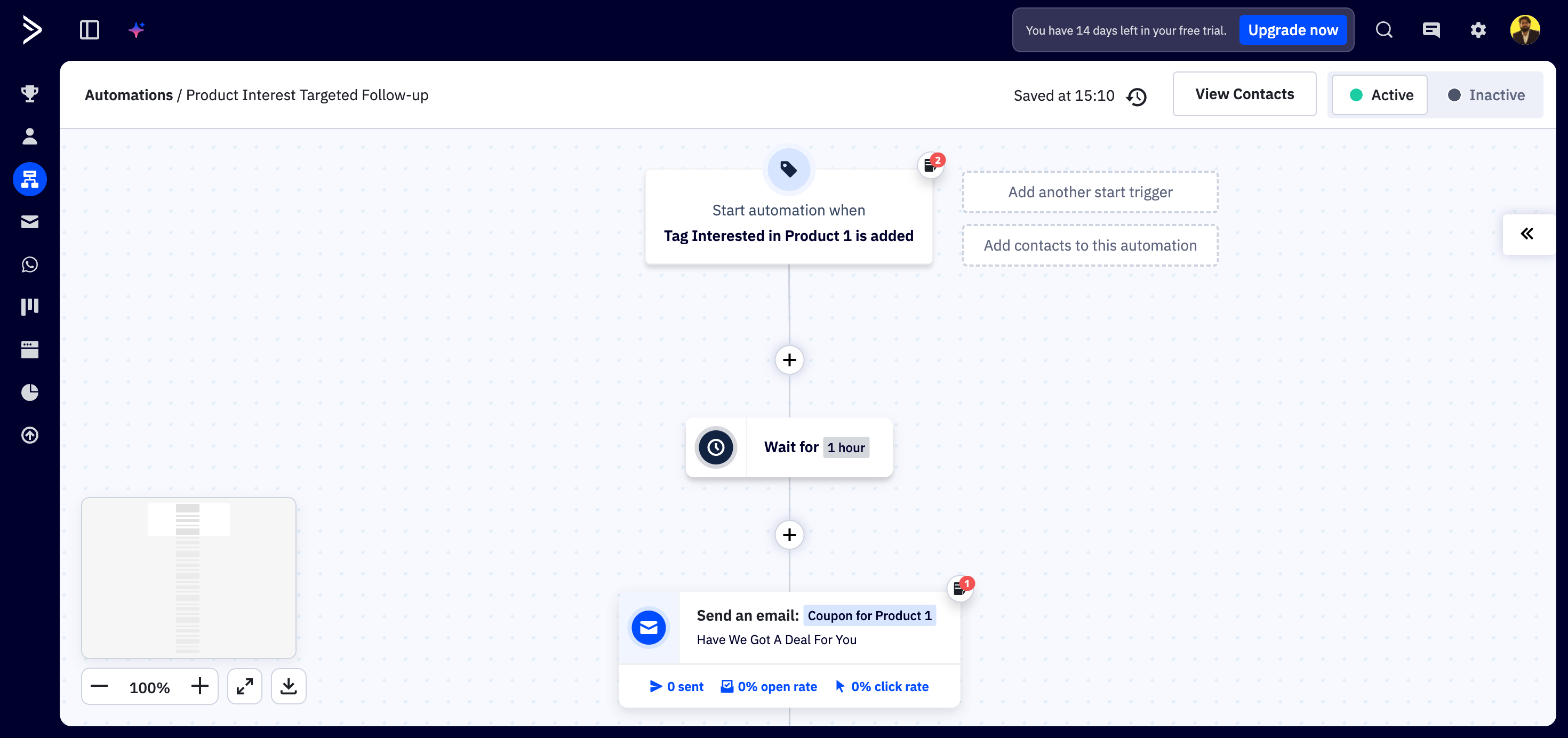
The platform handles more than just email. You can coordinate the following within a single workflow:
- Communication: SMS, WhatsApp, and on-site messages.
- CRM Tasks: Automatic lead scoring and deal updates.
- Behavioural Responses: The system reacts differently depending on whether a contact engages or stays silent.
ActiveCampaign also offers over 1000 pre-built automation recipes categorized by industry. You can pull a proven structure into your account and build on top of it immediately.
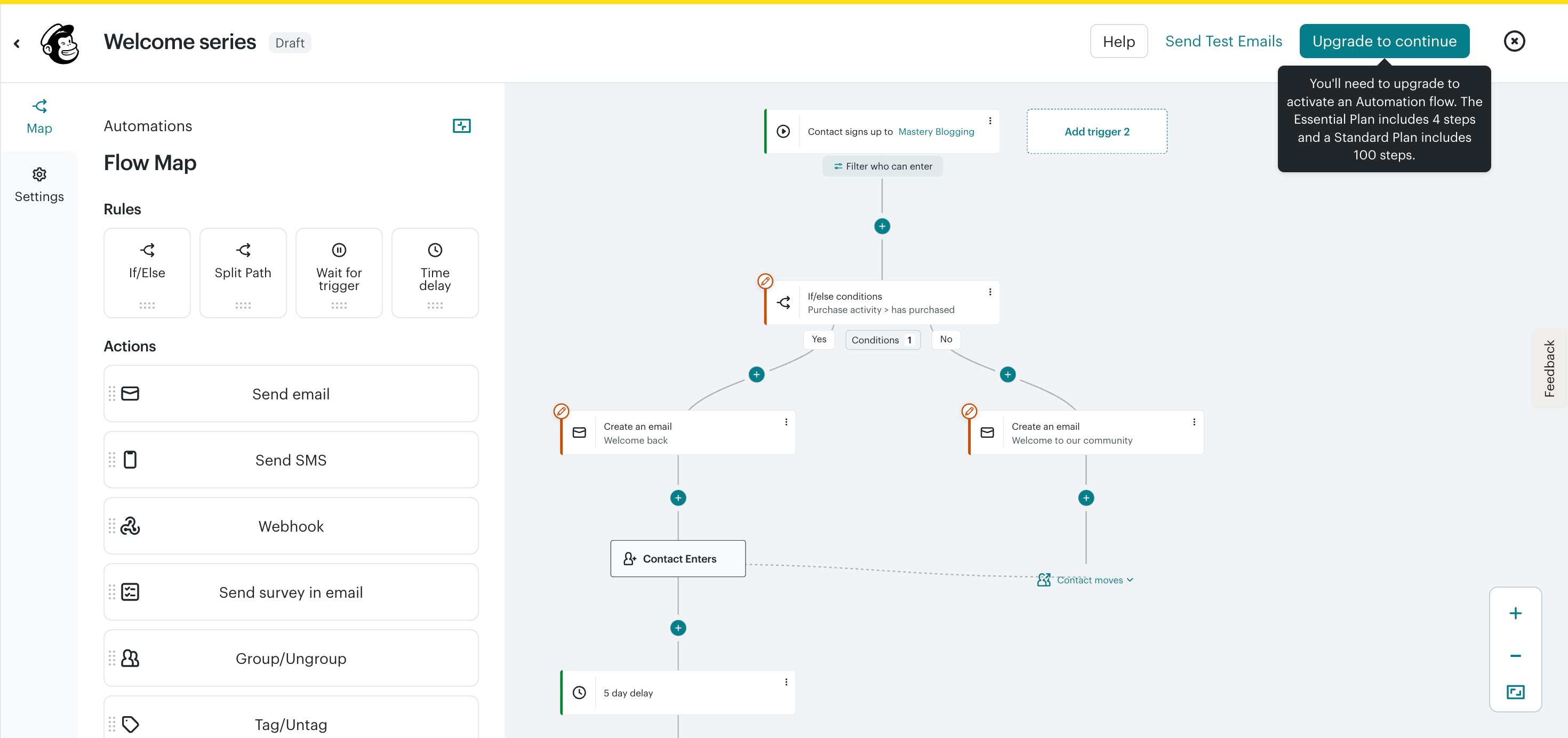
Mailchimp targets users who need standard sequences without much fuss. Its “Marketing Automation Flows” cover the essentials, such as welcome series, abandoned cart reminders, and re-engagement emails.
You can build these flows using basic rules, time delays, and branching paths. It works well for “set it and forget it” tasks, but the depth of these tools often depends on which subscription level you pay for.
The Verdict
Mailchimp has improved its automation over time, but it still trails behind.
When your campaigns need more depth and control, ActiveCampaign can replace multiple manual steps with a single workflow that runs on its own.
So, the first round goes to ActiveCampaign.
Email Templates – Which One Makes Better-Looking Emails?
How do ActiveCampaign and Mailchimp compare in terms of design?
Let’s find out.
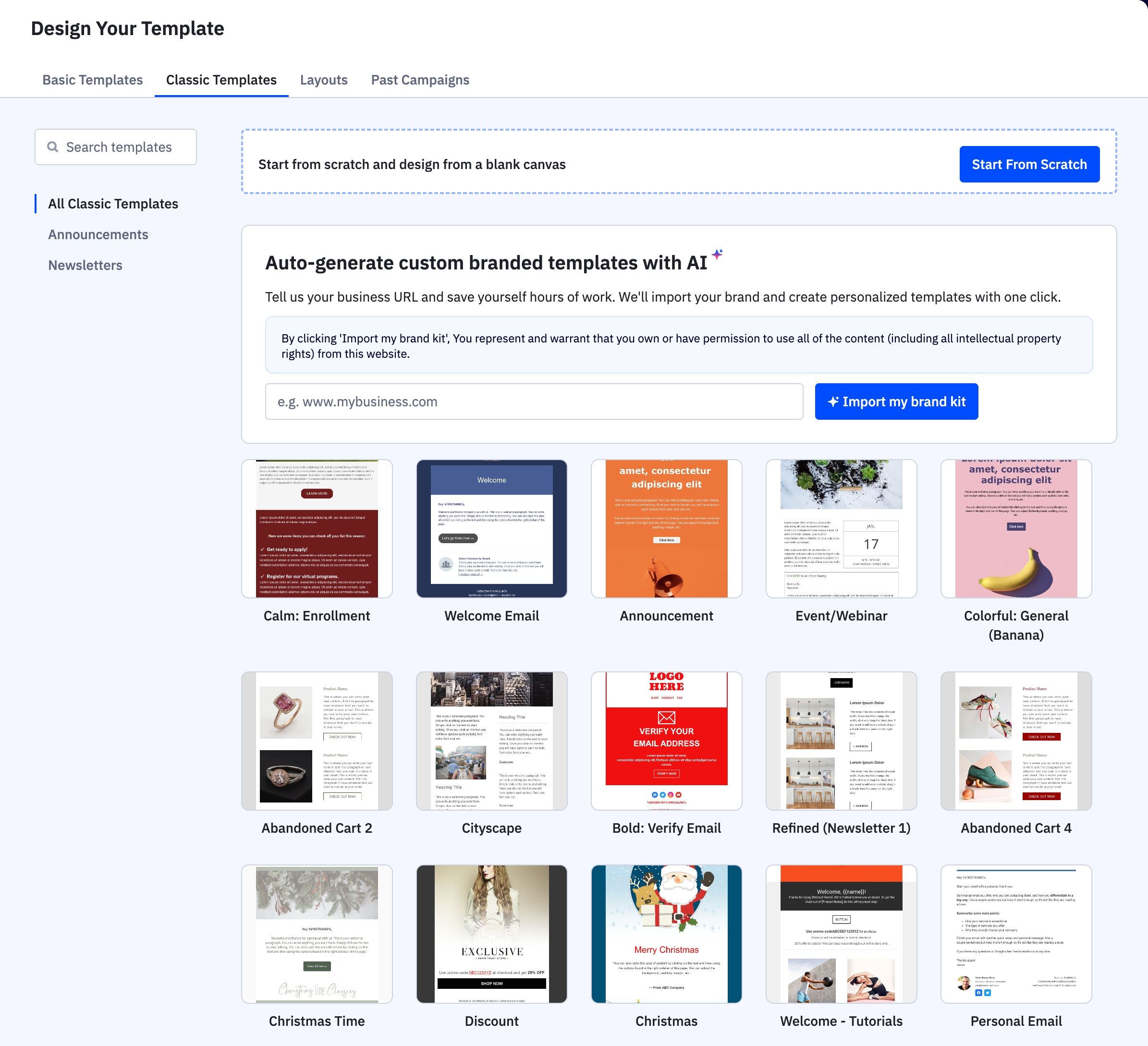
ActiveCampaign prioritizes control. It suits people who want to dictate exactly how an email looks and behaves. You can pick from over 250 templates or use a prompt to generate a starting point. The editor lets you build layouts piece by piece, and you can switch to a full HTML editor if you need to match a specific brand style.
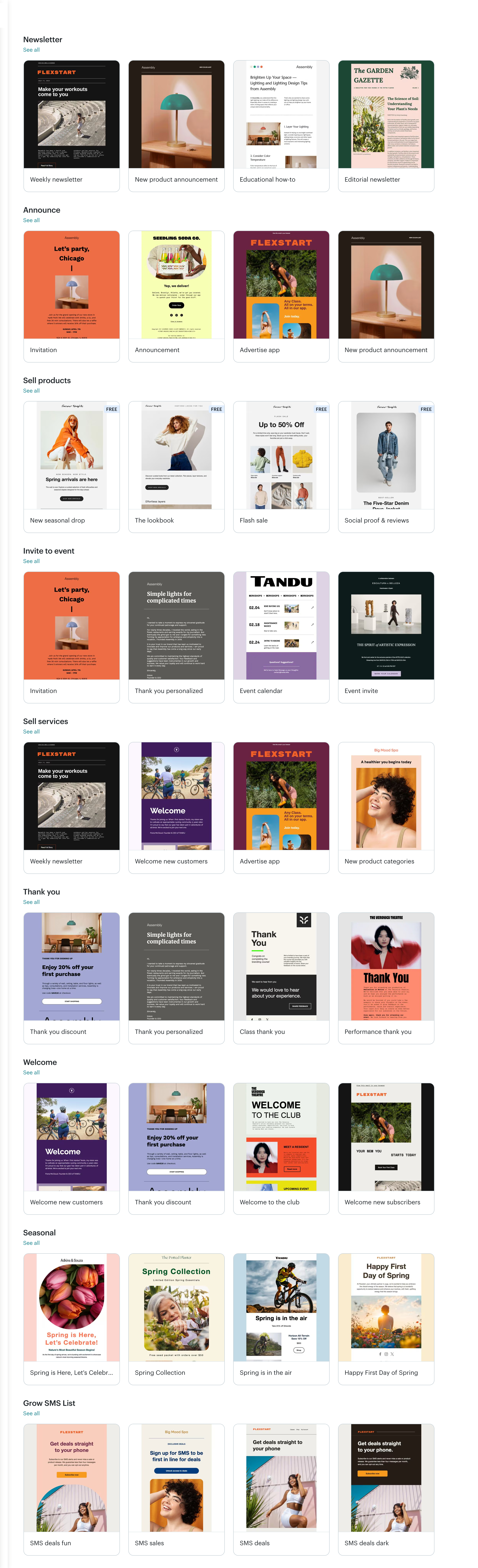
Mailchimp focuses on speed. Its builder relies on a template-first method, so you can put together a professional-looking message without much effort. It includes a drag-and-drop tool and lets you upload custom HTML if you pay for a higher-tier plan.
Mailchimp previously offered more design help through its Creative Assistant.
Since moving its AI tools under Intuit Assist, many of those features are hard to find or have been removed. Intuit Assist helps with writing, but that feature is still in beta.
So, which one comes out on top here?
ActiveCampaign takes this round because it ensures everyone can use and navigate its layouts without trouble.
Deliverability and Performance
Before we dive into this section, let me quickly explain something first:
Let’s say you write a great email.
Good subject line. Strong message. Clear call to action.
But it lands in spam.
Game over.
That’s why deliverability matters more than most people think.
First, what does “deliverability” even mean?
Simple:
It’s the chances of your email landing in someone’s inbox… instead of spam or promotions.
And it depends on things like:
- your sender reputation
- how people interact with your emails
- how your platform manages sending
Now let’s compare ActiveCampaign and Mailchimp on deliverability.
ActiveCampaign prioritizes the technical foundations of inbox placement. They build their infrastructure around list hygiene and strict authentication protocols. You can manage native domain verification—specifically SPF, DKIM, and DMARC—directly within the platform. If you send high volumes of mail, you can also opt for a dedicated IP address.
The system manages bounces automatically. You can also set up automated workflows to remove inactive subscribers, maintaining your list’s health without manual effort. These layers of protection help shield your sender reputation from damage.
For users who want expert eyes on their account, ActiveCampaign offers one-on-one deliverability consultations for $79 per hour. If you prefer a DIY approach, they provide a deep library of documentation on monitoring and improving your reputation.
Mailchimp maintains a solid reputation for standard marketing campaigns. They focus heavily on managing their shared-IP pools to ensure most customers see steady results. Like its competitor, Mailchimp offers dedicated IPs for high-volume senders who need more control over their own traffic.
The Verdict
ActiveCampaign provides more technical controls for users who prioritize scaling and precise inbox placement. Mailchimp offers a dependable experience for standard newsletters, with upgrades available as your needs grow. In fact, 95% of users who switched from Mailchimp to ActiveCampaign say deliverability was the main reason behind their decision.
Ease of Use and Interface – Which Platform is Simpler?
Let’s look at how ActiveCampaign and Mailchimp compare when you actually sit down to use them.
Mailchimp wins if your only metric is how fast you can fire off a single email. It’s built for speed at the starting line. But real ease of use isn’t just about that first send; it’s about how much effort you have to put in every week as your business grows.
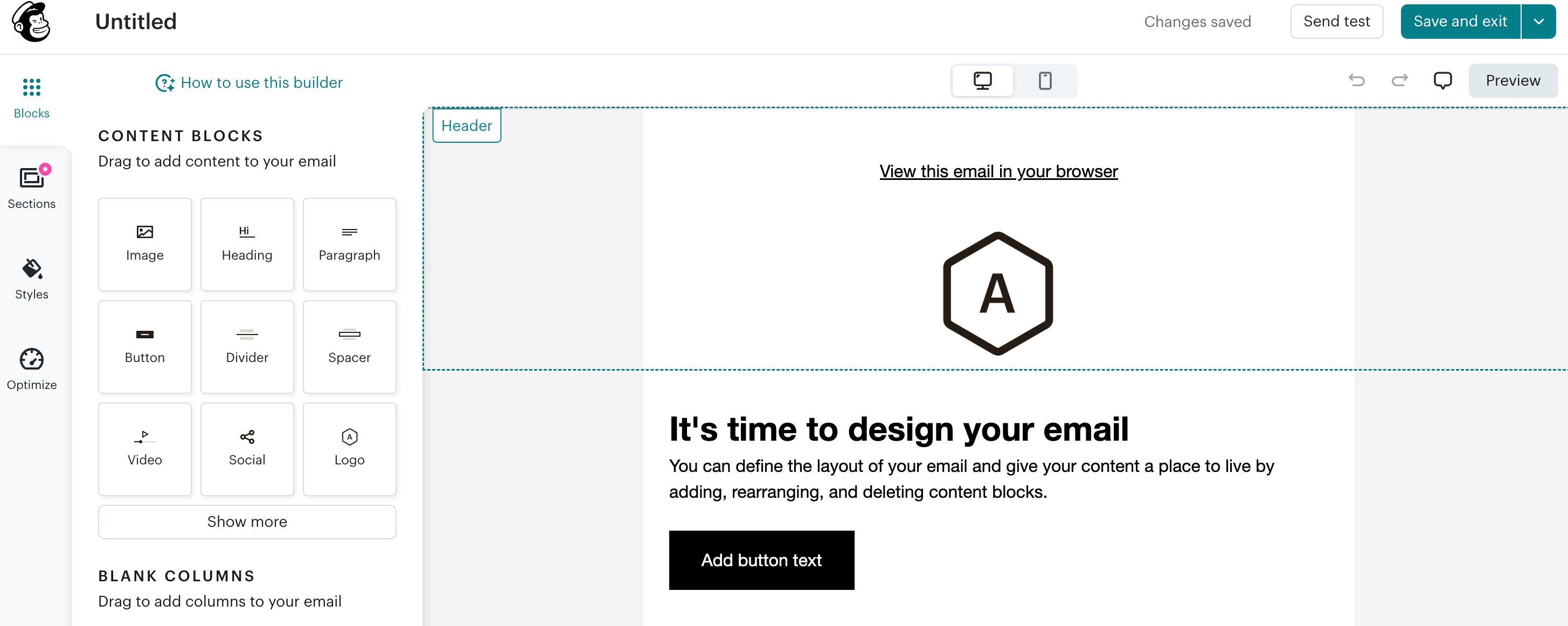
Image: Mailchimp User Interface
People often assume that more power equals more headaches. While ActiveCampaign handles complex tasks that simple tools can’t touch, power doesn’t have to mean frustration. The platform provides direct onboarding and pre-built recipes to help you see results right away.
The real difference shows up once your marketing becomes more advanced. In Mailchimp, deeper personalization often leads to more manual work. You may end up creating separate lists, rebuilding segments for each campaign, and duplicating messages for different audiences. It works, but it can become repetitive as your targeting gets more detailed.
ActiveCampaign works differently. You can build one automation that reacts to customer behaviour, engagement, and data in real time. Instead of recreating campaigns for every audience segment, you can set up a single workflow that branches on its own. On top of that, built-in templates, automation recipes, and AI-backed suggestions reduce the amount of repeated setup as your marketing expands.
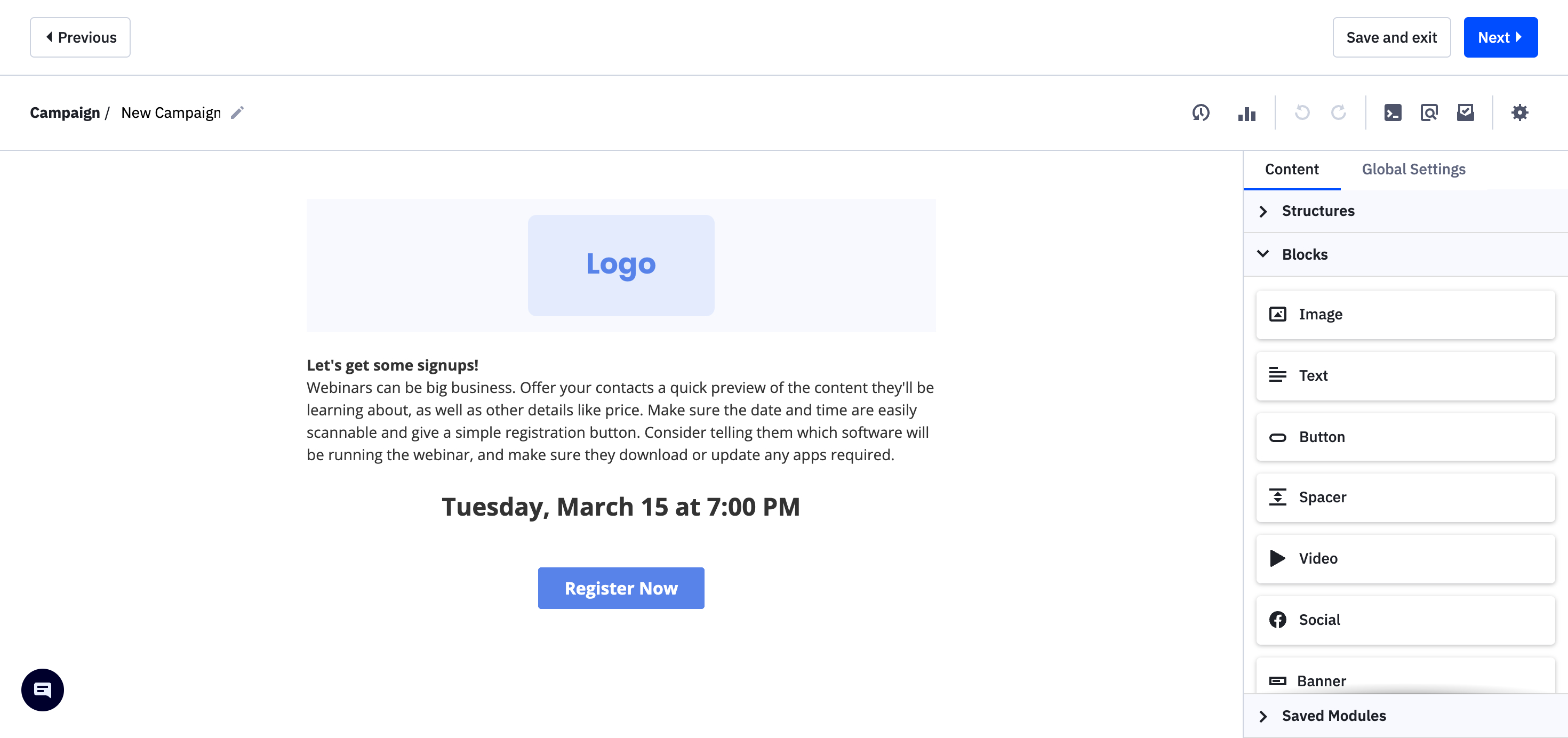
Image: ActiveCampaign User Interface
The Verdict
Mailchimp takes the lead if you only care about the first five minutes of setup. But if you value your time over the long haul, ActiveCampaign provides the best balance of depth and usability. You won’t find another platform that scales this well while remaining this intuitive.
In fact, the average person using ActiveCampaign recovers 10 hours of their life every month by offloading manual chores to the platform.
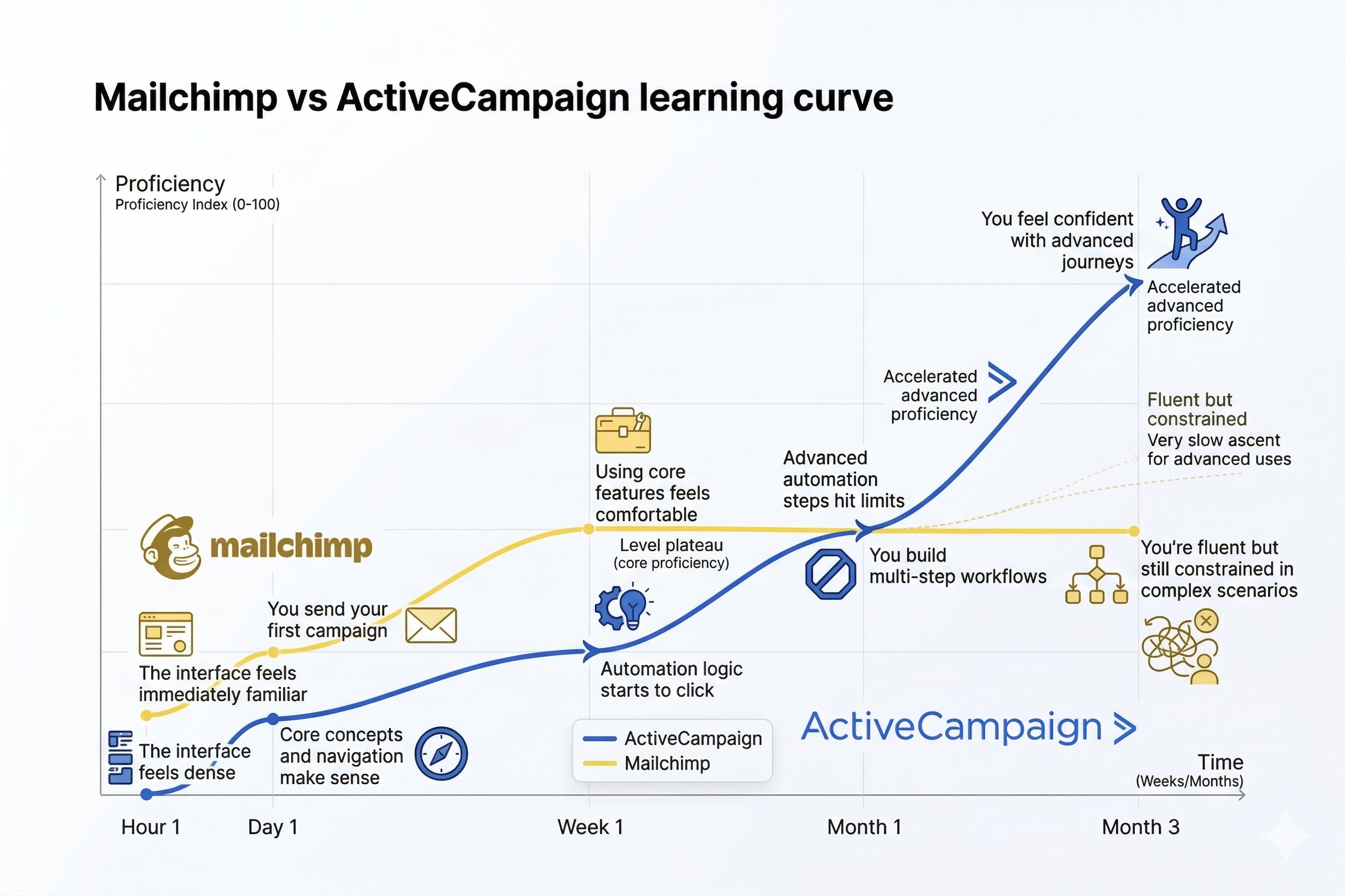
Image Credit: SendPulse
Design and Spam Testing
Mailchimp handles design testing with ease. Beyond the standard desktop and mobile views, the “Inbox Preview” tool displays how your email renders across various email clients. If you have a monthly plan, you receive 25 tokens every month to use this feature, and you can buy extra tokens if you run out.
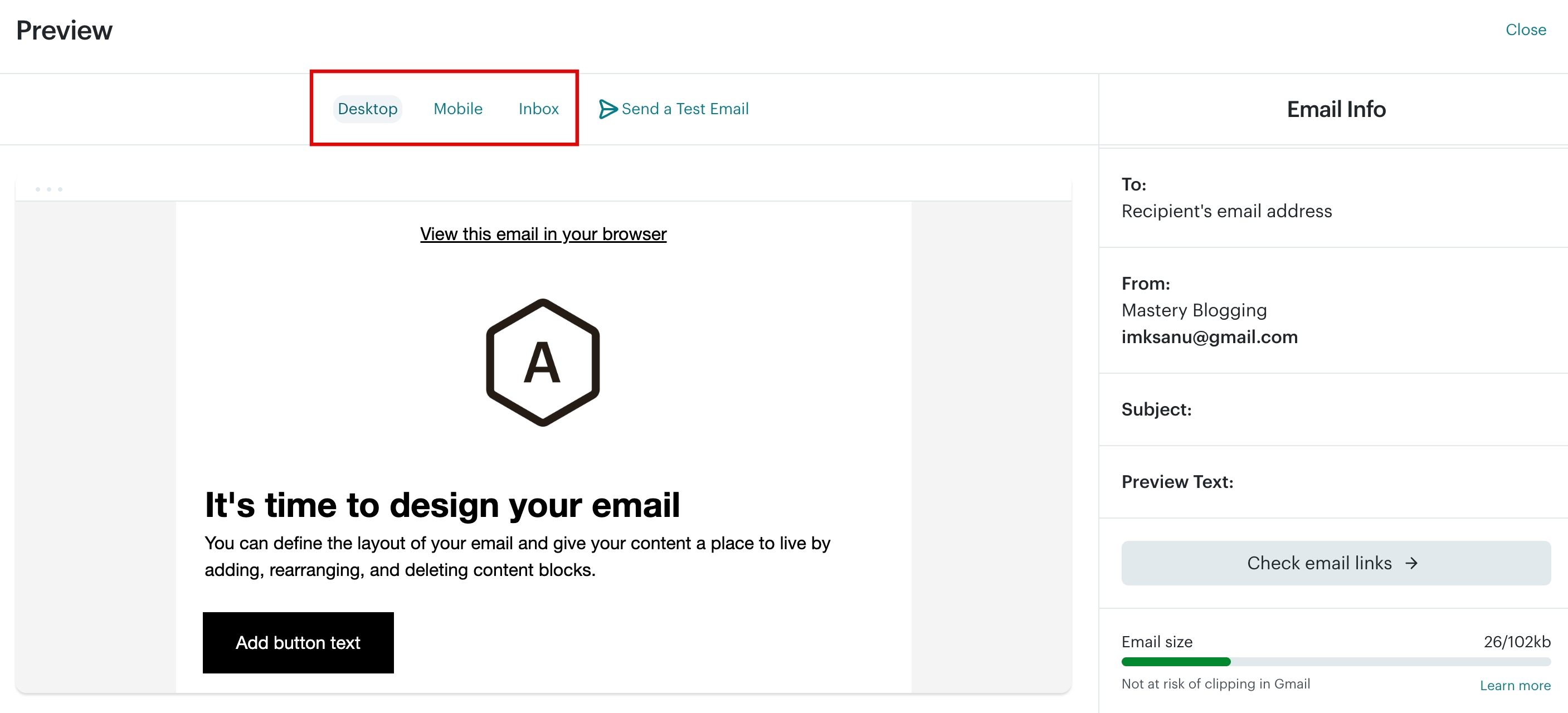
A built-in link checker also hunts for broken or missing URLs before you hit send. You can even use the mobile app to see how the layout looks on your own phone. However, Mailchimp lacks any internal spam testing tools.
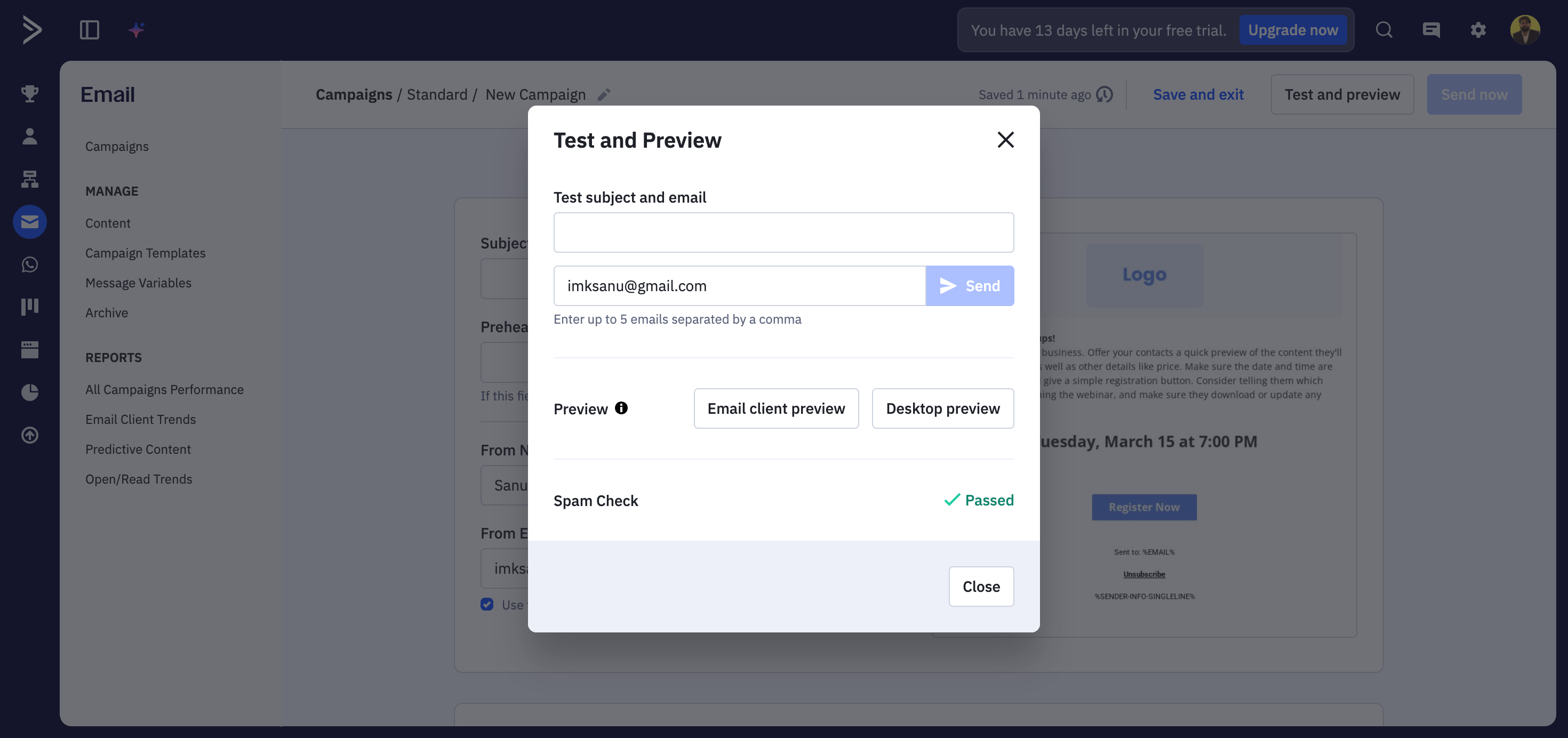
ActiveCampaign takes the opposite path. They include a spam check powered by SpamAssassin that scans every message before it goes out. Unfortunately, their design previews only cover desktop and mobile formats. If you want to see how your email looks in specific clients, you have to pay $5 for every five tests. Those costs pile up fast if you send frequent campaigns.
The Verdict
It’s a tie. Mailchimp wins on design previews, but ActiveCampaign takes the lead on spam testing.
Segmentation and Personalization
When comparing ActiveCampaign and Mailchimp in terms of segmentation and personalization, the difference mainly comes down to depth versus simplicity.
ActiveCampaign tracks what users actually do rather than just looking at their profile data. You can mix various conditions to create dynamic segments that update automatically based on engagement and activity signals.
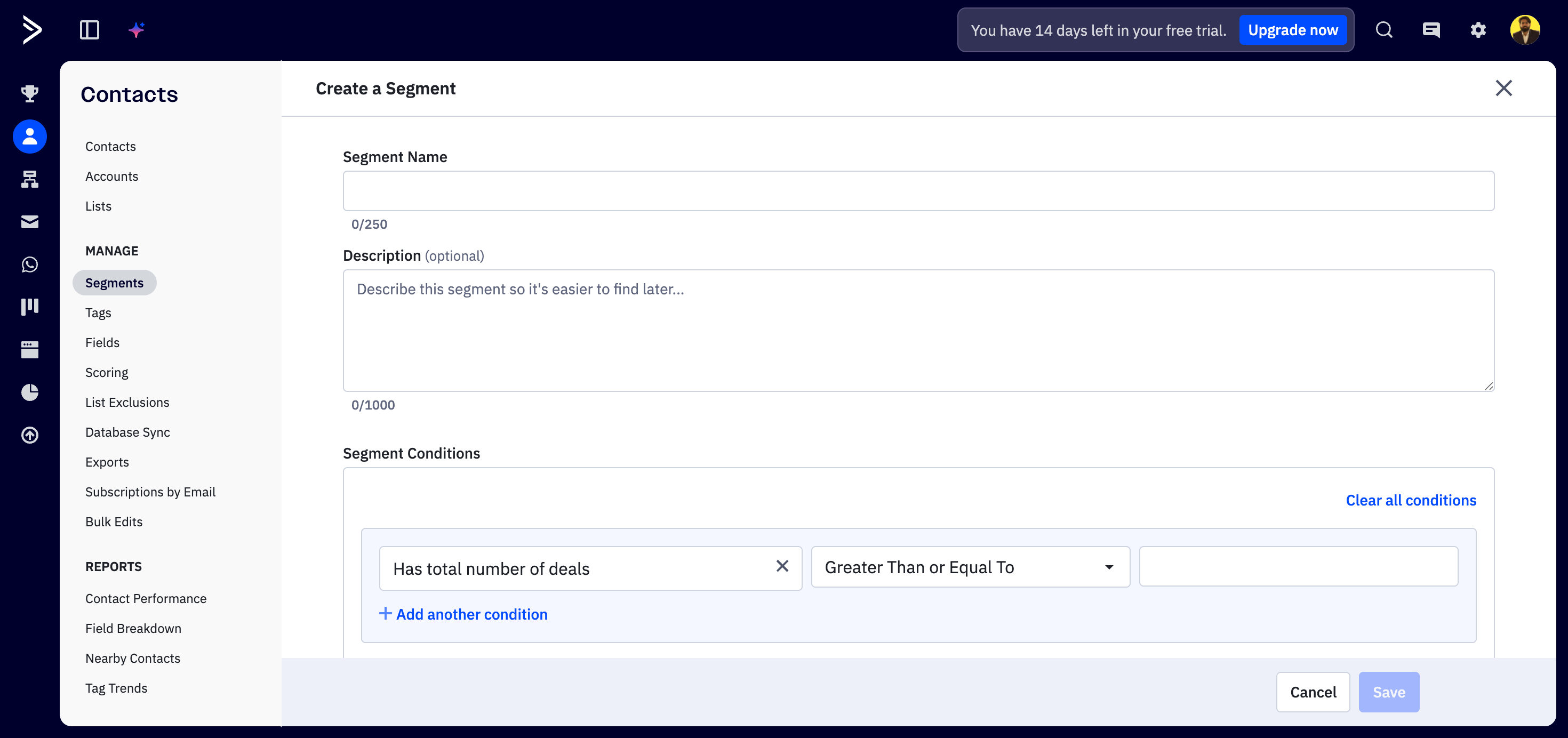
The platform also uses AI to suggest segments, which saves you from building new filters every time you launch a project. This identifies intent and interest automatically.
When it comes to the actual emails, ActiveCampaign uses conditional content blocks. This means you can swap out images or text for different readers inside a single email. You won’t have to build five different versions of the same newsletter just to show a specific offer to a specific group.
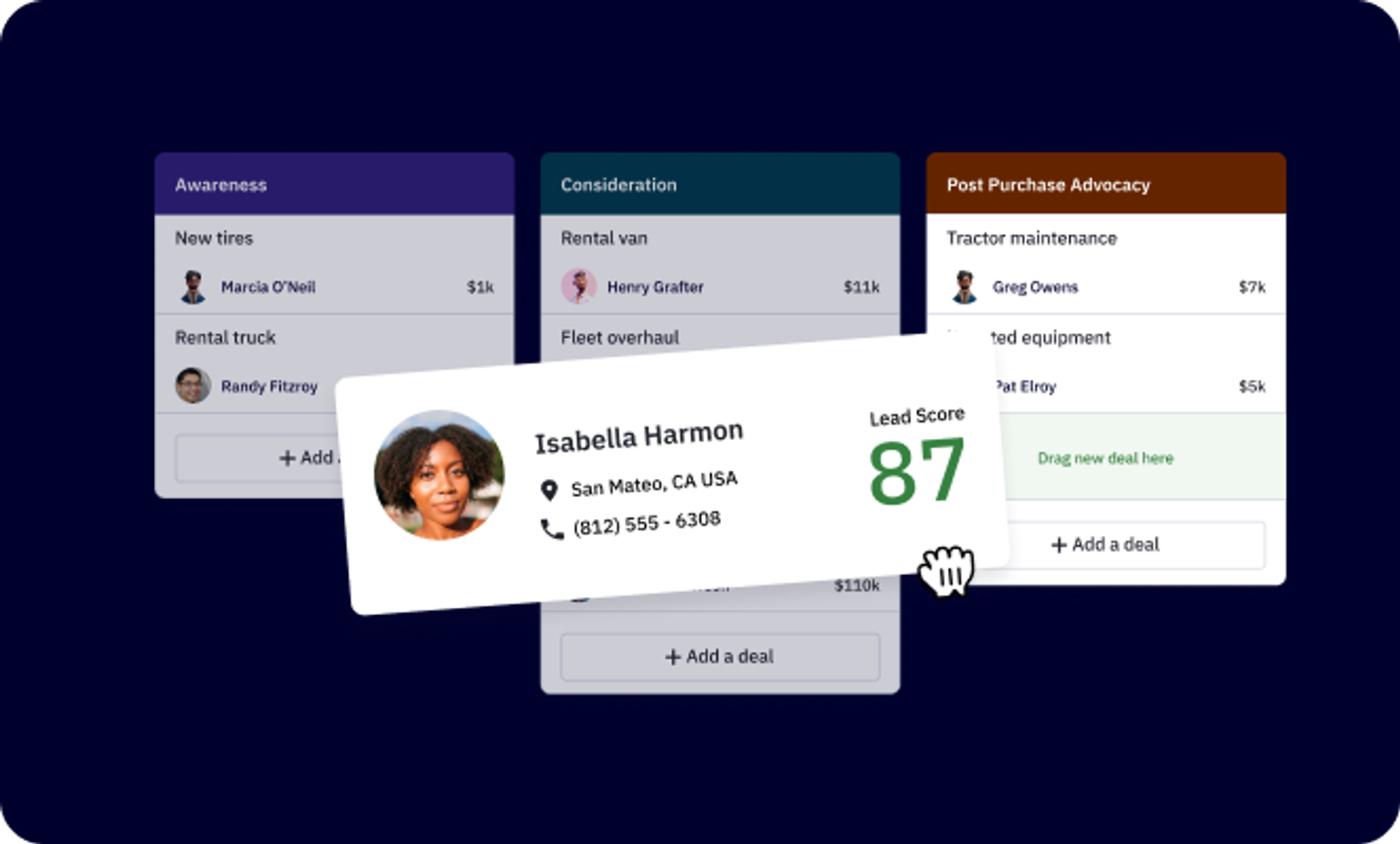
On top of that, ActiveCampaign includes lead scoring. You can assign points based on user behaviour, which helps you identify your most engaged subscribers.
Mailchimp takes a more traditional approach. It relies heavily on static segments and manually curated lists. While it provides pre-built suggestions to help you get moving, the segmentation mostly centers on audience data and basic activity.
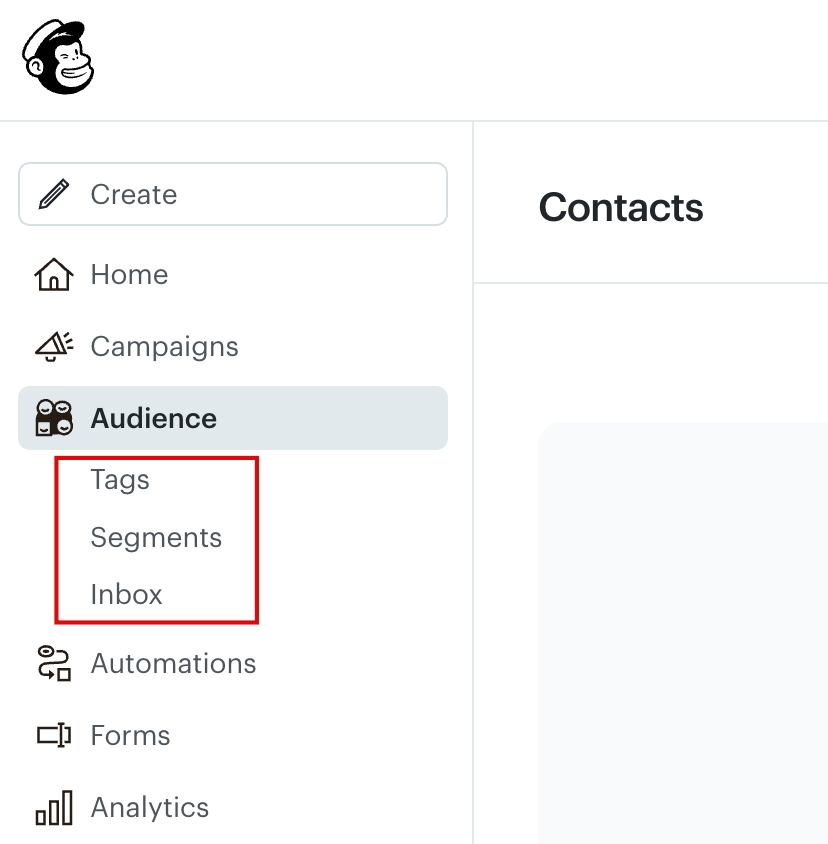
For personalization, Mailchimp uses merge tags and audience fields. This system works well for small teams that need to get an email out the door without navigating complex logic. While it does offer dynamic content, those triggers usually stay tied to broader categories or list-wide tags.
So, which one wins here?
Overall, Mailchimp is easier to use and works well if your needs are simple. But if you want precise targeting, dynamic segmentation, and more control over how you personalize campaigns, ActiveCampaign offers a much stronger system.
Registration Forms
Signup forms come built into almost every email marketing tool now. But when you actually try to create one, the experience can feel very different. Let’s compare how ActiveCampaign and Mailchimp handle it.
ActiveCampaign offers several form types, including inline, floating bar, floating box, and modal pop-ups. The editor feels simple and visual, so you can build and edit forms without confusion. Adding new fields takes just a few clicks, and everything stays in one place.
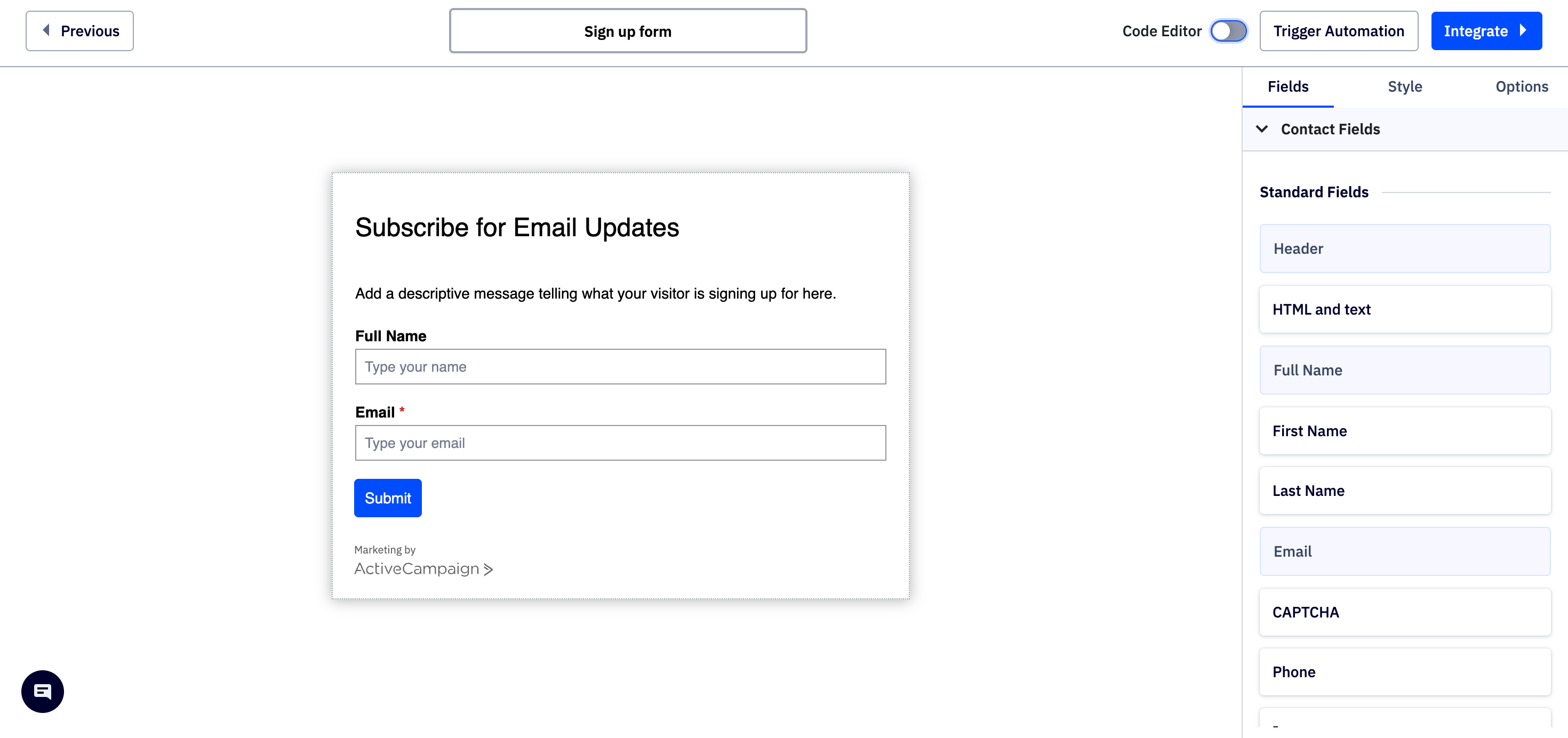
You can embed these forms on your website, share them through a link, or connect them directly to WordPress or Facebook if you’ve set up those integrations.
It also lets you tie forms to lists, tags, and even deals, which makes it more useful for managing leads.
Mailchimp also supports embedded and pop-up forms, but the setup feels more complicated. While the form builder itself is easy to understand, you end up using different editors depending on the type of form you create. That makes the process feel inconsistent.
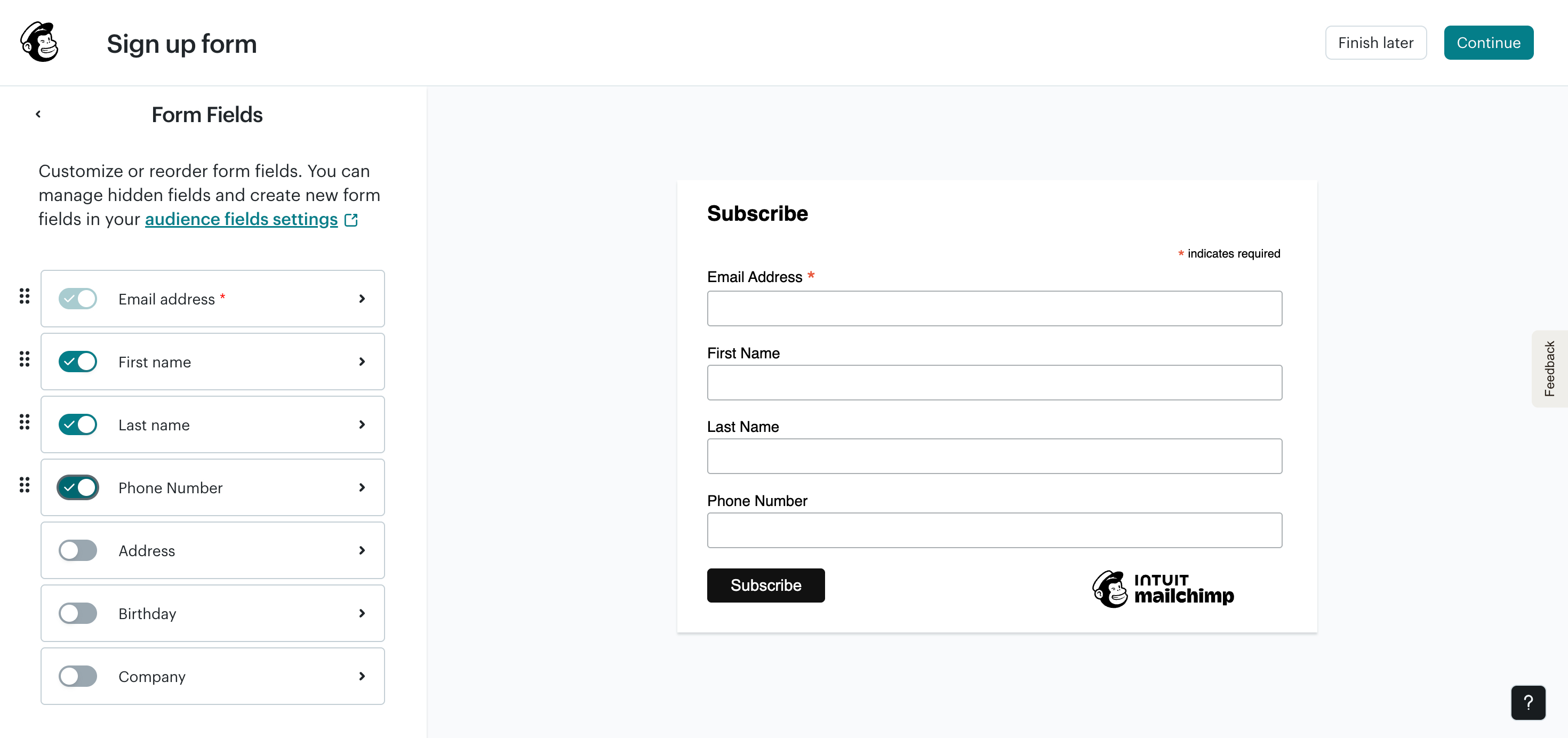
Another downside is that some Mailchimp forms don’t always adapt well to mobile devices, which can affect conversions.
The Verdict
ActiveCampaign wins this round. They kept their system unified and simple, while Mailchimp turned a basic task into a chore.
Sales Alignment and CRM Capabilities
When you compare ActiveCampaign and Mailchimp in terms of CRM and sales alignment, the gap becomes quite noticeable once you look at how each platform handles leads and sales processes.
ActiveCampaign provides a dedicated Sales CRM within the platform. It connects your marketing data directly to your revenue goals. You can manage deal pipelines, assign tasks, and automate the entire sales process.
You can access these tools via two different add-ons, provided you use the Plus plan or above.
Because your data lives in one place, a lead’s behaviour—like opening an email or visiting a specific web page—can trigger immediate sales actions. The system can automatically create a deal, notify a sales rep, or advance a prospect to the next stage of your funnel. This creates a direct path from an initial click to a closed sale.
Mailchimp views “CRM” through a marketing lens. It excels at organizing contact data and tracking how people interact with your emails. Its features help you segment your audience and improve your targeting, but it lacks the infrastructure to manage a sales team’s daily workflow.
For instance, Mailchimp uses a star-based rating system to show who interacts with your content most often. This helps you identify active leads, but it doesn’t allow you to track individual deals, manage sales quotas, or assign owners to specific opportunities. If you need to manage a sales pipeline, you will have to integrate a third-party CRM.
The Verdict
Overall, Mailchimp handles the basics if you only need to send emails and keep a simple list of contacts. However, ActiveCampaign fills the gaps when you need to track leads, close deals, and actually get your sales and marketing teams on the same page.
Reporting and Analytics
When it comes to reporting and analytics, ActiveCampaign and Mailchimp again follow two different paths. One focuses on depth and business insights, while the other focuses on simplicity and quick reporting.
ActiveCampaign links performance directly to your business goals and how contacts move through their lifecycle. It looks past simple email metrics to show how your marketing actually impacts your bottom line. You can track performance across entire automations to see how full customer journeys perform.
Here’s what the analytics dashboard looks like in ActiveCampaign. This is a new account, so no emails have been sent yet.
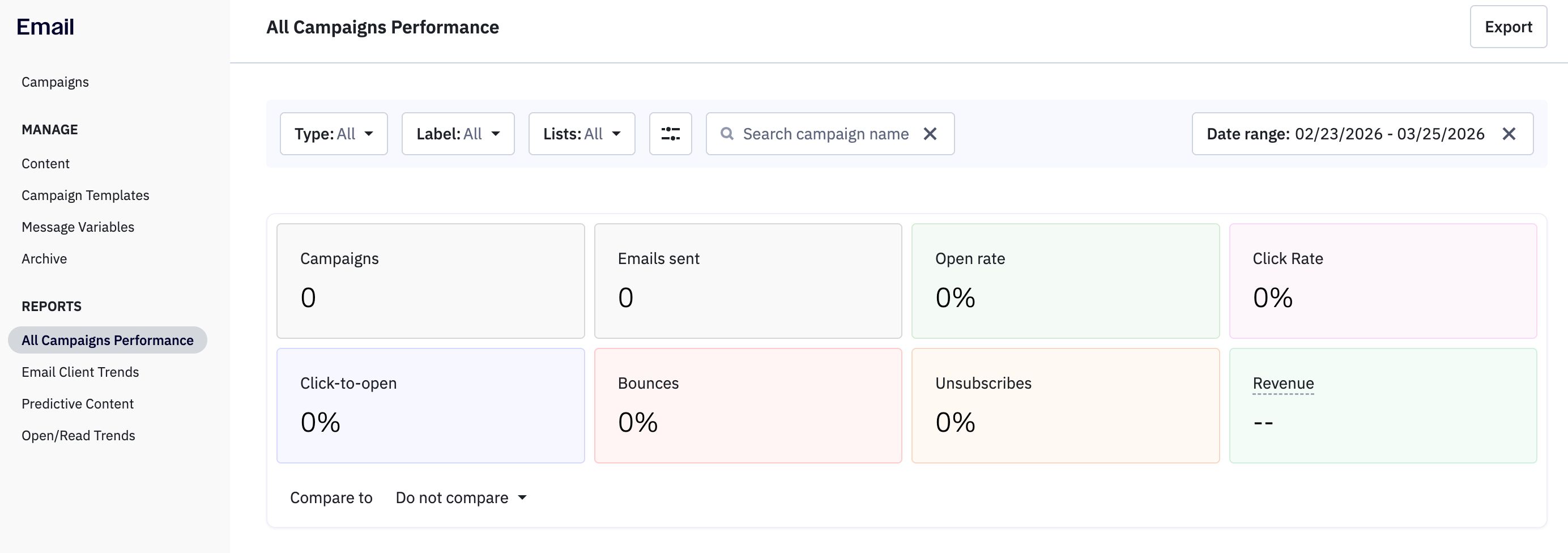
Depending on your plan, you also get detailed views into contact behaviour, form submissions, sales deals, and e-commerce trends.
The platform also includes attribution modelling. You can use first-touch, last-touch, or multi-touch models to see which channels drove your results. Recent updates introduce AI Business Goals, where you define a specific objective and let the system track your progress. The AI then points out which tactics are working and suggests your next move.
Mailchimp centers its reporting on the individual campaign. It helps you understand engagement through opens, clicks, and audience signals so you can improve your creative work and sending schedule. It excels at showing how a specific blast performed and comparing it to previous ones.
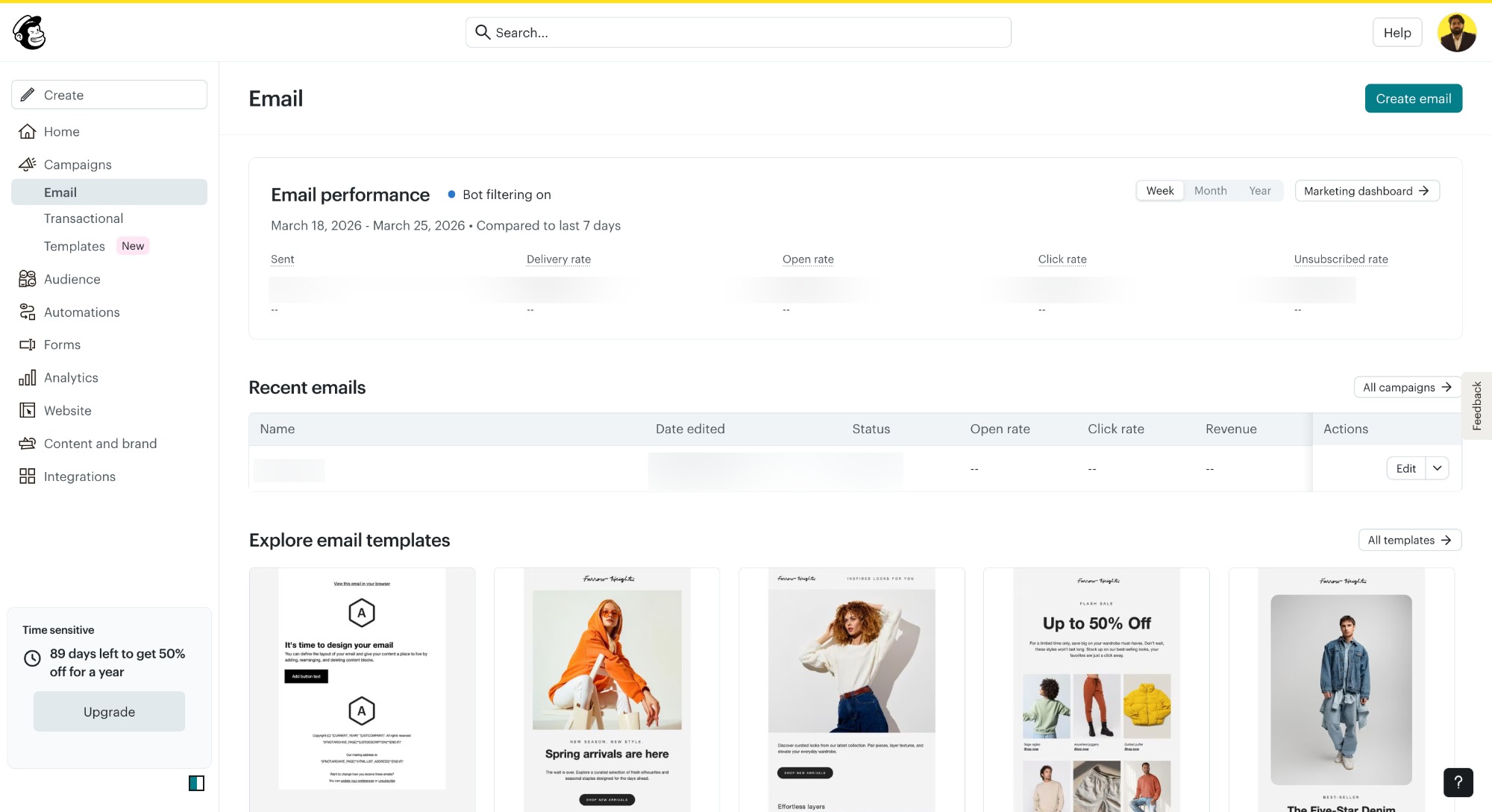
While it makes these metrics easy to read, it offers less depth for tracking goals or cross-journey analytics within the platform.
The Verdict
If you need to know how every marketing touchpoint influences your bottom line and sales pipeline, ActiveCampaign provides that depth. If you just want to see how your latest email performed so you can improve your next one, Mailchimp keeps the data simple and actionable.
AI Features
AI has become a catch-all term that marketing platforms slap onto any automated feature. To find the actual value, you have to look past the label. Does the tool truly remove tasks from your schedule, or is it just adding noise to your dashboard?
ActiveCampaign treats AI as a foundational layer rather than a bolt-on feature. Instead of just helping you write a headline, it builds and manages entire campaigns from start to finish. They call this “Active Intelligence,” and it functions like an experienced assistant that handles campaign creation, automation building, and data analysis in a single workspace.
In practice, this looks like the AI Campaign Builder, which takes a basic text prompt and generates a full campaign—not just the text. The AI Actions Library goes further by inserting intelligent agents into your workflows that adapt to your needs without you writing code.
For teams managing global brands, these tools protect your identity while you scale. You can feed your brand assets into the AI Brand Kit, and it produces ready-to-use email templates in minutes. If you have an international audience, AI Translations converts subject lines and body text into over 75 languages based on what each recipient prefers. To ensure people actually see your work, Predictive Sending analyzes individual behaviour to deliver emails at the exact moment a person is likely to open them, which boosts click-through rates by 17%.
When it’s time to review your results, you can simply ask the platform how a campaign performed or why a specific segment lagged behind. It provides summaries and charts immediately, so you don’t have to hunt through raw data.
Mailchimp focuses its AI on specific suggestions and surface-level edits. Most of these features now live under Intuit Assist, a beta tool that creates emails within existing templates and offers basic predictive data. However, the platform recently retired several tools, such as its Creative Assistant, which has narrowed its creative AI scope.
They offer send-time optimization to help improve open rates, though they categorize this as data science rather than true AI. This analysis happens at the list level rather than looking at each individual contact. For global reach, Mailchimp translates hosted forms into 50+ languages by detecting a subscriber’s browser settings.
The Verdict
While Intuit Assist suggests Mailchimp has more updates coming, ActiveCampaign currently handles much more of the manual workload. If you want a platform that genuinely takes tasks off your plate today, ActiveCampaign holds a significant lead.
Landing Page Builder
Most email platforms now include landing page tools, and both ActiveCampaign and Mailchimp follow this trend. Mailchimp adopted the feature early on, while ActiveCampaign joined the party a bit later.
The main difference comes down to cost. Mailchimp offers the builder in its free version.
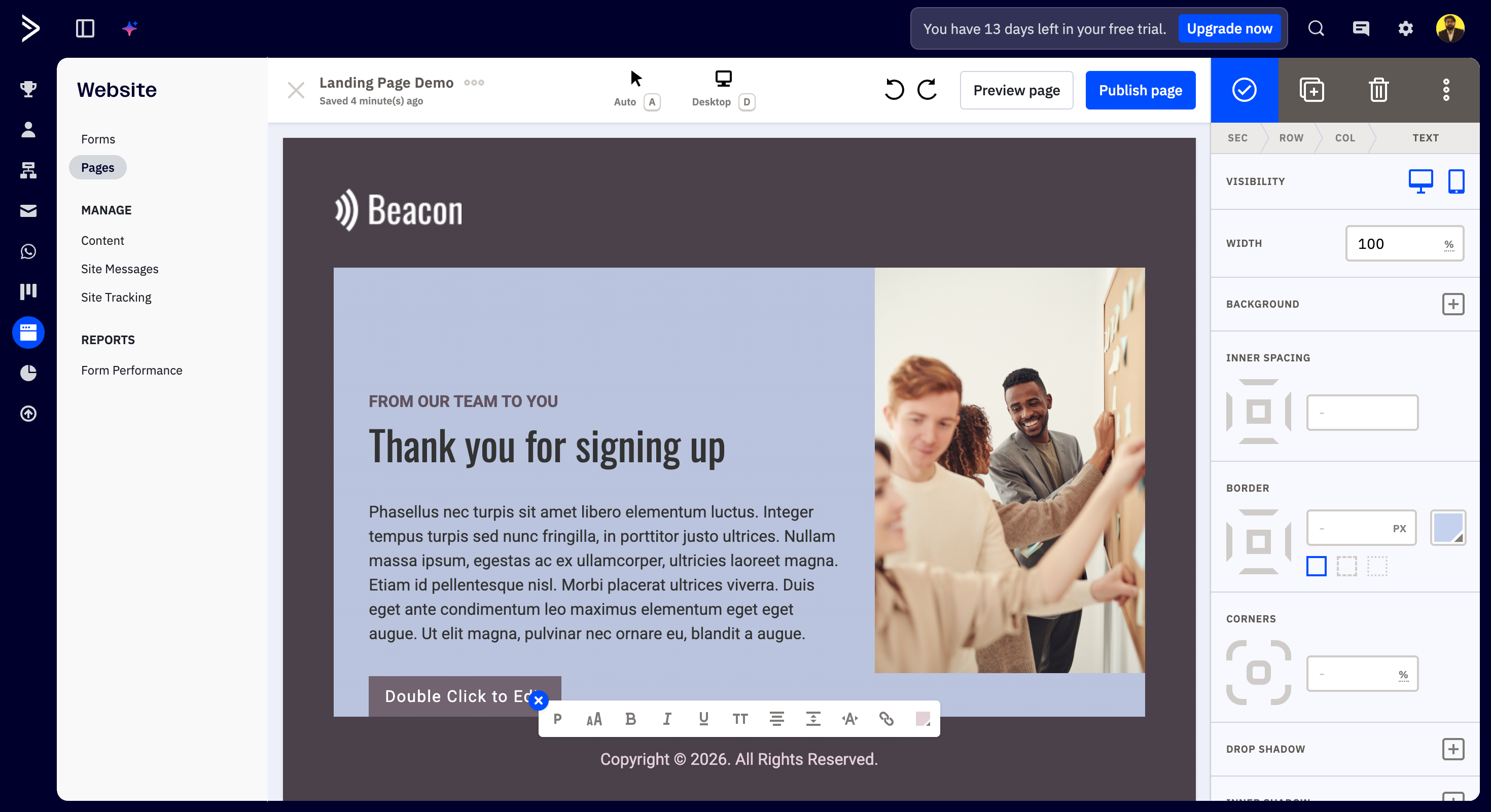
ActiveCampaign requires a “Plus” plan or higher. Because ActiveCampaign costs more, it provides advanced options. For example, you can show or hide specific content to personalize what visitors see. They offer over 250 professional templates and let you use your own domain.
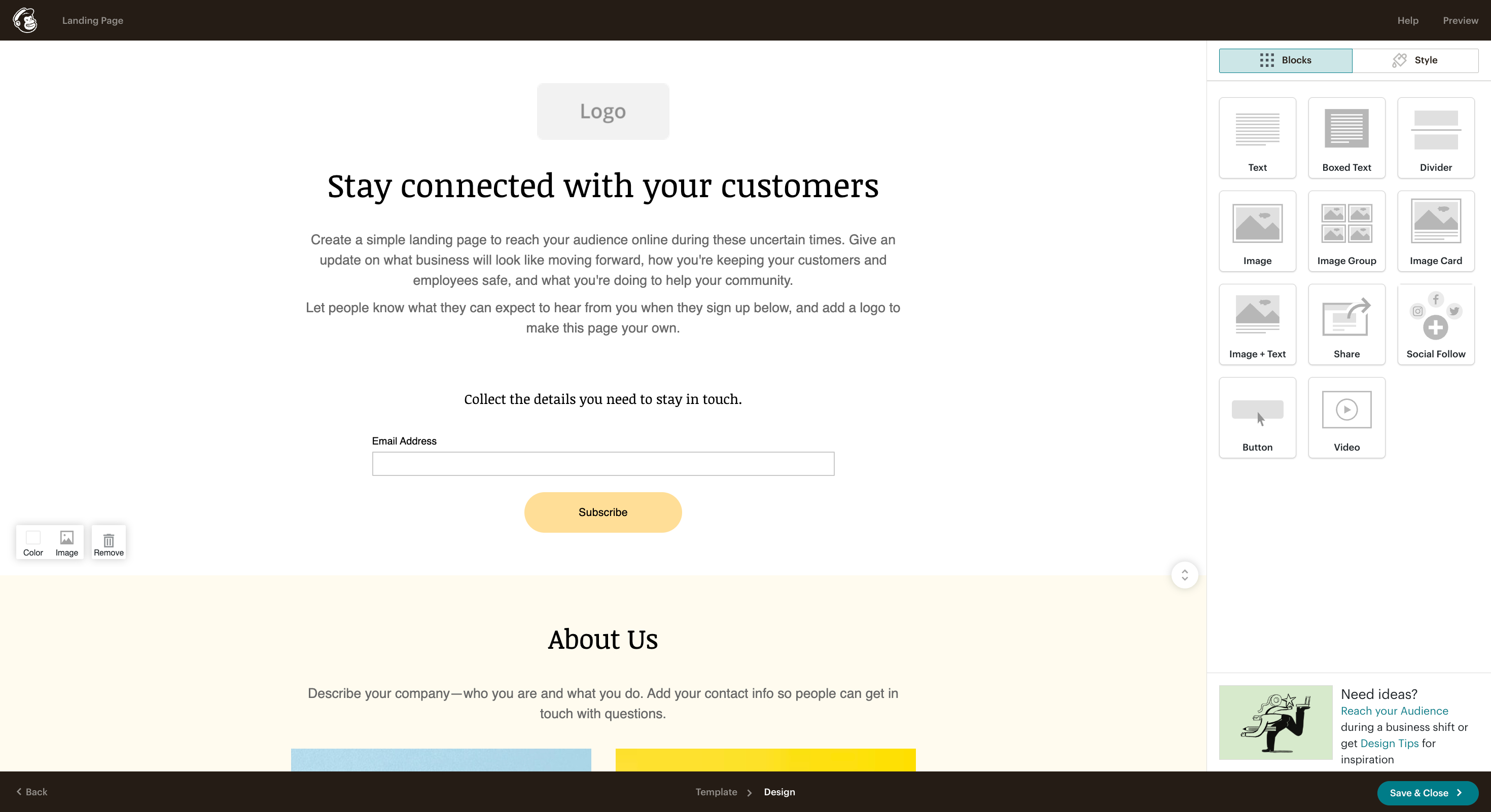
Mailchimp prioritizes ease of use. It allows you to sell products directly from the page, which helps small shops. They provide more than 100 templates.
The Verdict
Mailchimp has fewer designs, but offering a functional landing page builder for free makes a big impact. They win this round.
Third-party Integrations
ActiveCampaign and Mailchimp both sit at the top of the market, which means they’ve built a massive web of compatibility. You won’t struggle to make either play nice with your current tech stack.
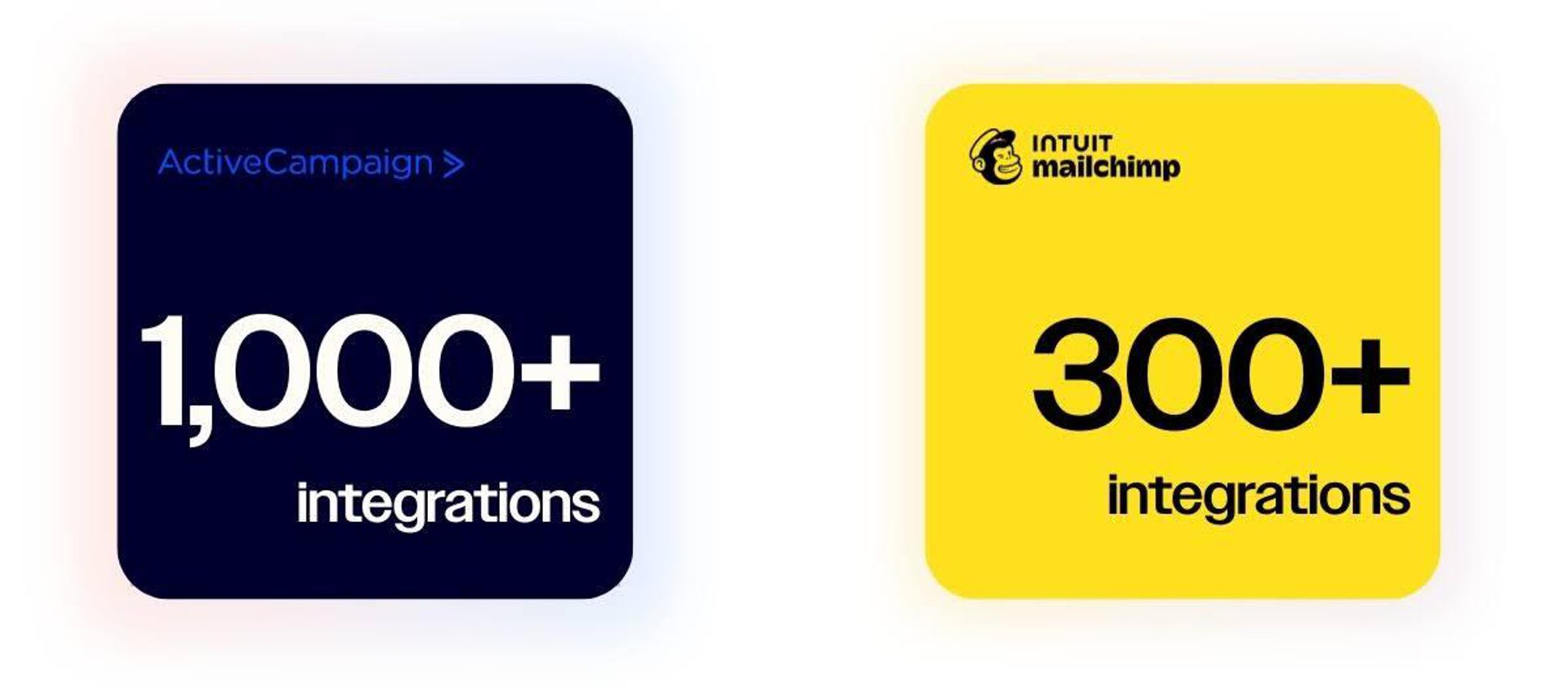
Mailchimp supports more than 300 apps. This includes the major CRM systems, e-commerce platforms like Shopify, website builders, and social media networks. They also work with Zapier if you need to bridge any gaps between niche tools.
ActiveCampaign goes even further, with 1000+ integrations across different categories. It also supports Zapier, so you can connect it with many additional apps beyond its native options.
The Verdict
While ActiveCampaign wins on paper with a higher total count, numbers fluctuate as developers release new updates. Both platforms cover the essential tools most businesses rely on daily. Because they both meet the core needs of the average user, I’m calling this a tie.
Customer Support and Community
When you pick a platform, support isn’t just a perk – it’s your safety net, particularly during a migration. The real gap between ActiveCampaign and Mailchimp lies in the level of human intervention you get during setup and how much your monthly bill dictates who you can talk to.
ActiveCampaign helps you get started without the usual DIY hassle. Their support includes:
- Human-Led Onboarding: They handle the setup and data migration for specific plans so you can start sending immediately.
- Expert Migration: They move your contacts and automations for you within set limits.
- Strategic Guidance: You can hire certified consultants or attend in-person training.
- Direct Access: They offer email support, an AI chatbot, and dedicated reps for Enterprise users.
- Knowledge Base: A community forum, webinars, and a searchable help center.
The big win here is the onboarding. With the right plans, their team builds your initial campaigns for you, which removes the technical burden from your plate.
Mailchimp uses a rigid, laddered system where your access to people increases as you pay more. Their offering includes:
- Email and Chat: Available only to users on a paid subscription.
- Phone Access: Only customers on the highest “Premium” tier can call for help.
- Guided Setup: New users on specific plans receive some help getting started.
- Knowledge Base: A massive library of tutorials meant for users who prefer solving problems themselves.
While Mailchimp provides excellent documentation for independent troubleshooting, they reserve their most direct human contact for their top-spending accounts.
The Verdict
ActiveCampaign wins on hands-on assistance. By combining migration services with proactive onboarding, they prioritize getting you fully operational. Mailchimp remains a strong choice for those who are tech-savvy enough to rely on guides, but their support feels more like a gatekept feature than a partnership.
Pricing Breakdown (September 2026 Update)
So far, ActiveCampaign seems to have the upper hand, especially when you look at the features it offers.
But what about pricing? How do ActiveCampaign and Mailchimp compare when it comes to cost?
At first glance, you might expect ActiveCampaign to be very expensive because of its advanced marketing automation tools. Surprisingly, that’s not the case. When you compare it with other enterprise-level marketing platforms, such as HubSpot, ActiveCampaign actually costs much less.
Let’s look at the entry-level plans for both platforms.
| Subscribers | ActiveCampaign (Starter) | Mailchimp (Essentials) |
|---|---|---|
| Free Plan | 14-day trial | Free for 250 contacts and 500 emails/month |
| 1,000 | $19/mo | $16.14/mo |
| 2,500 | $49/mo | $24.75/mo |
| 5,000 | $99/mo | $41.42/mo |
| 10,000 | $189/mo | $62.40/mo |
If you run a small email list, the prices of ActiveCampaign and Mailchimp look fairly similar at first. However, ActiveCampaign becomes cheaper if you choose an annual plan, which can reduce the cost by 20%.
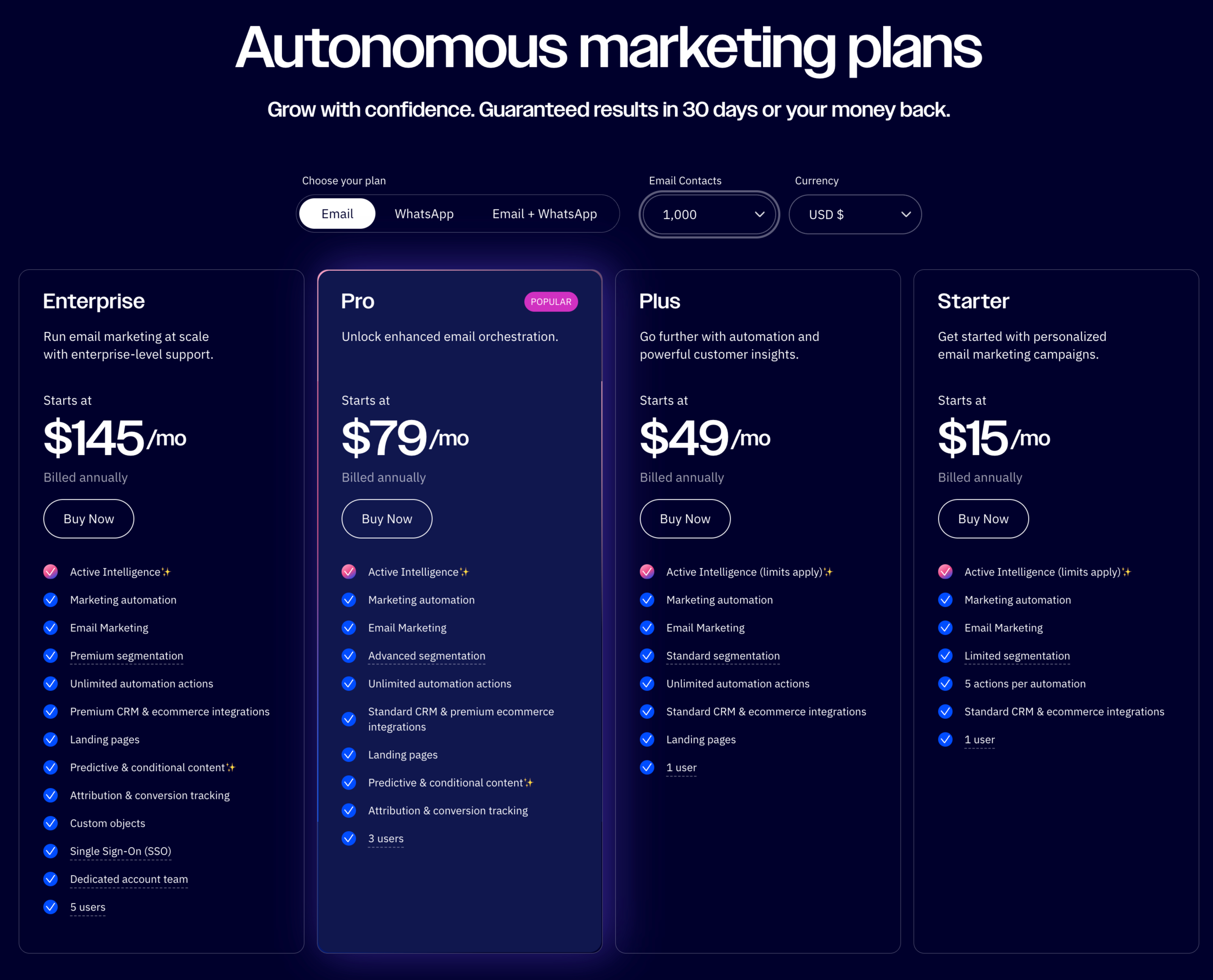
See results in 30 days or get your money back.
That said, the pricing above applies to ActiveCampaign’s lowest marketing tier, the Starter plan. This plan does not include several important features such as CRM, lead scoring, advanced data integrations, or landing pages. To access those features, you must upgrade your plan and add the CRM package.
Mailchimp handles this differently. Most of its useful tools already come with the Essentials plan. However, a few advanced options remain locked behind the Premium plan. These include advanced segmentation, comparative reports, multivariate testing, and premium support.
The Premium plan starts at $243.86 per month. At that price, many users may find it difficult to justify the cost.
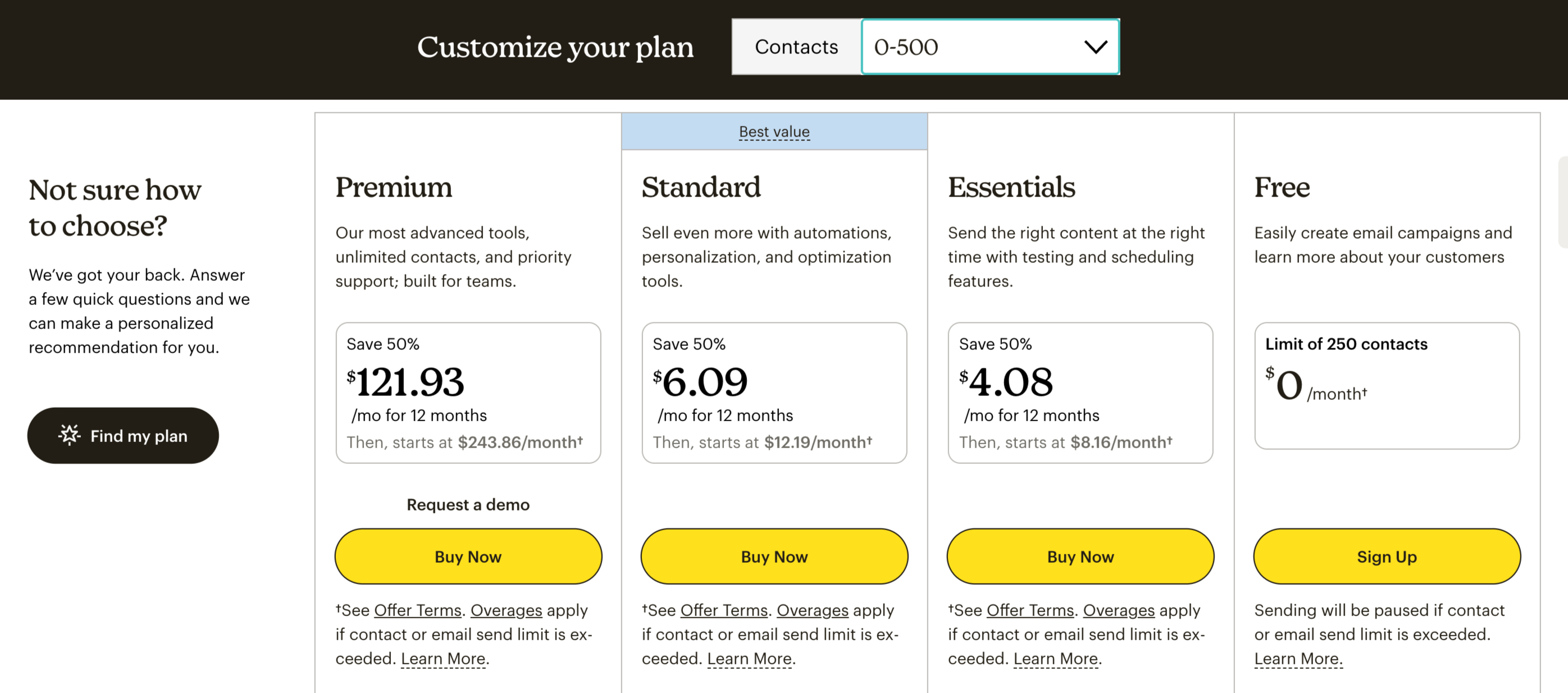
Note: Mailchimp is currently available at 50% off at the time of writing this article.
Mailchimp still has a couple of advantages. It offers a Forever Free plan with limited contacts and sending limits. It also provides prepaid plans.
ActiveCampaign does not include either option and instead offers a 14-day free trial, and you don’t need a credit card to sign up.
The Verdict
This isn’t a simple comparison. At first glance, Mailchimp looks cheaper. But when you look at what you actually get for the price, ActiveCampaign offers better value.
ActiveCampaign avoids double-charging for the same contact across multiple lists and keeps its pricing straightforward without hidden costs. Mailchimp, on the other hand, charges per subscriber per list, which can increase your total cost over time.
Both platforms serve slightly different types of users, so comparing them directly has its limits. Still, based on pricing and what each platform offers, Mailchimp ends up costing more for similar features.
For that reason, ActiveCampaign wins this round—and takes the overall win as well.
ActiveCampaign vs. Mailchimp – Winner Summary Table
| Category | Winner |
|---|---|
| Marketing Automation | ActiveCampaign |
| Email Design and Templates | ActiveCampaign |
| Deliverability and Performance | ActiveCampaign |
| Ease of Use | ActiveCampaign |
| Design and Spam Testing | Tie |
| Segmentation and Personalization | ActiveCampaign |
| Registration Forms | ActiveCampaign |
| Sales Alignment and CRM Capabilities | ActiveCampaign |
| Reporting and Analytics | ActiveCampaign |
| AI Features | ActiveCampaign |
| Landing Page Builder | Mailchimp |
| Third-party Integrations | Tie |
| Customer Support | ActiveCampaign |
| Pricing | ActiveCampaign |
| Customer Reviews | ActiveCampaign |
| Overall Winner | 🏆 ActiveCampaign 🏆 |
Customer Reviews of ActiveCampaign and Mailchimp
What other customers are saying about ActiveCampaign and Mailchimp? Let’s find out.
On G2, ActiveCampaign holds a 4.5-star rating, while Mailchimp follows closely at 4.4 stars.
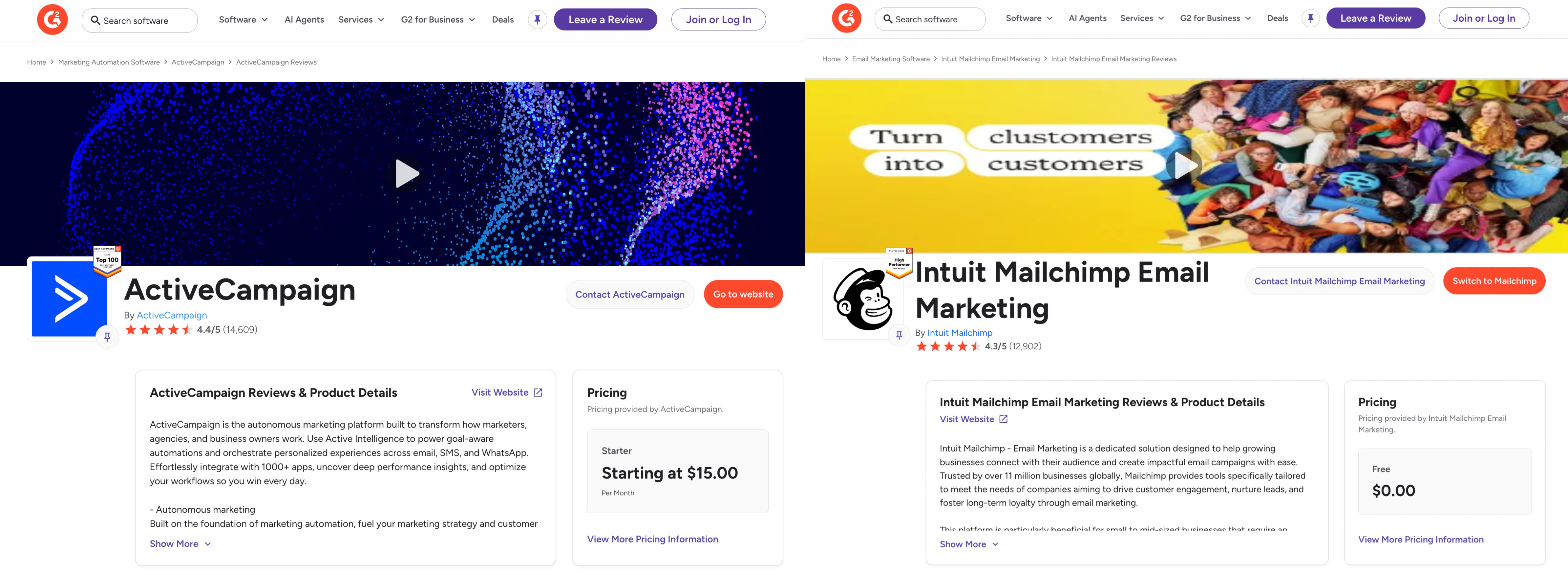
Over on Capterra, the gap remains small, with ActiveCampaign at 4.6 and Mailchimp at 4.5.
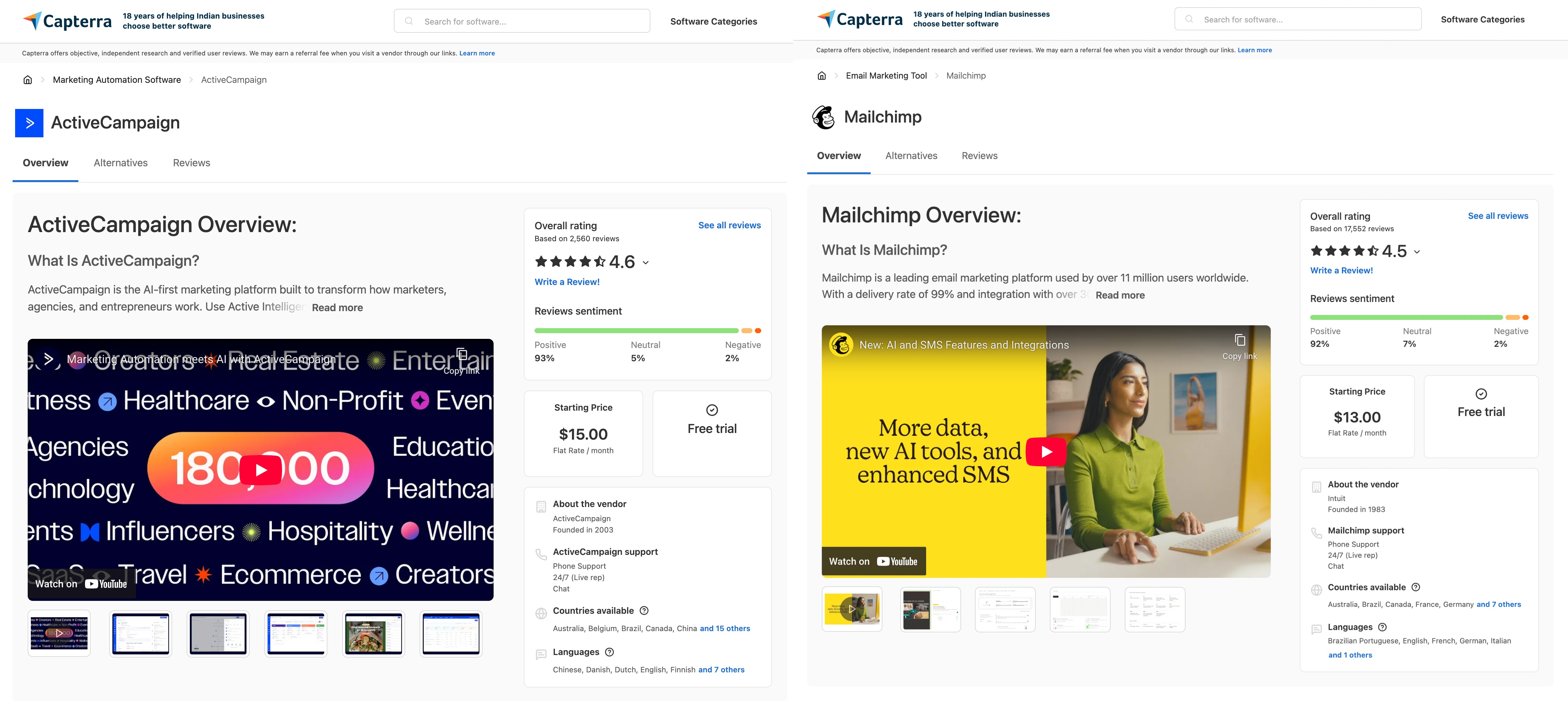
I switched to ActiveCampaign myself, and the difference in my results has made me a loyal fan. But you don’t have to rely only on my experience.
Here is what other verified users have to say on G2.
“We were using Mailchimp previously, which didn’t have adequate automation options available, and their lists/audiences process was overcomplicated. They also charged for duplicate email addresses that appeared in several lists, whereas ActiveCampaign only charges once per email that appears in several different lists, which is preferable. We’re using the automation feature in ActiveCampaign to reduce the amount of time we have to manually send out email campaigns.” – Matt L.
“Before we started using ActiveCampaign, we were using MailChimp, and we felt really limited. There was no way to segment our lists effectively, and we couldn’t set up different automations for various segments, which was a big challenge. Once we switched to ActiveCampaign, the experience improved significantly. We had an excellent onboarding person who walked us through the setup, which made the transition smoother. Overall, it’s been a great tool for us, and we’ve been really happy with it.” – Chaya M.
“Mailchimp’s email builder is quite basic, so don’t expect to create highly advanced email designs. The triggers and automations are suitable for basic needs, but they don’t compare to the advanced capabilities of Klaviyo or ActiveCampaign, particularly in the e‑commerce field.” – Roman D.
“Mailchimp was easy to use, but our deliverability rates were just so awful. ActiveCampaign’s inbox receive rates were way better. There were a bunch of factors that y’all were taking into account that other email providers just weren’t. So we switched.” – Nyk Rayne, Director of Operations @ UN|HUSHED.
Real-World Success – Why Businesses Are Switching From Mailchimp to ActiveCampaign
When you look beyond features and pricing, the real difference shows up in results. Many businesses that moved from Mailchimp to ActiveCampaign report noticeable improvements in engagement, automation, and overall growth.
Here are a few real-world examples:
Case Study – UN|HUSHED
The Challenge: Dealing with poor deliverability and stagnant engagement on Mailchimp.
The Result: A massive 238% increase in open rates immediately after switching to ActiveCampaign. By leveraging superior inbox placement and automated segmentation, they reached a 60.3% newsletter open rate.
Read the full UN|HUSHED case study.
Case Study – Palmetto Fortis
The Challenge: Limited growth and low visibility into the customer journey.
The Result: Open rates jumped from 22% with Mailchimp to 52% with ActiveCampaign. Beyond just engagement, the switch helped drive 20% Year-over-Year (YoY) sales growth through intelligent lead scoring and Salesforce integration.
Read the full Palmetto Fortis case study.
Real Results for Former Mailchimp Users
The shift isn’t just happening to a few brands, it’s a massive trend for growing companies.
Every month, 600+ businesses leave Mailchimp for ActiveCampaign because the results speak for themselves. Those who make the move don’t just change tools; they see actual growth.
Here is what happens when you switch:
- 82% of users hit a positive ROI in less than a year.
- 67% of users spend less to acquire new customers.
- Email open rates double on average.
- 3x faster campaign building with AI.
- 10+ hours back in your schedule every single week (520 hours/year).
Better Reach, Faster Setup
Deliverability is the backbone of email marketing, and the data shows why people migrate.
95% of switchers cite inbox placement as their primary reason for leaving Mailchimp. ActiveCampaign holds the #1 spot with a 93.4% deliverability rate, while Mailchimp sits at #3 with 92.6%.
The best part? You won’t lose days to technical debt. Most businesses finish their entire migration in under two hours.
Still not convinced?
Watch the video below to see how Parrish Law Firm quadrupled its results. They jumped from a 10% open rate to 40% simply by moving their email marketing from Mailchimp to ActiveCampaign.
Who Should Use Mailchimp?
While the success stories above favour ActiveCampaign, Mailchimp remains a global leader for a reason. It isn’t “bad” software; it’s simply built for a different type of user. You should likely stay with (or choose) Mailchimp if:
- You are a true beginner: If you are sending your first email campaign, Mailchimp’s drag-and-drop editor beats everything else for ease of use. You will master the basics much faster here than you would with ActiveCampaign.
- You mostly send newsletters: Your focus is on updates, promotions, and simple welcome messages.
- You want everything in one spot: You need landing pages and basic ads alongside your emails.
- Low volume / small budget: For side hustles or small hobbies with under 250 contacts, Mailchimp’s free (or lower-tier) plans are often more wallet-friendly than jumping straight into a CRM like ActiveCampaign.
The bottom line: Mailchimp is perfect for beginners and small businesses that need a simple email marketing tool.
Who Should Use ActiveCampaign?
ActiveCampaign works best when you need power rather than a basic email sender.
You should choose ActiveCampaign if:
- Automation is your priority: You need multi-step funnels, triggers based on how people act, and lead scoring. You build complex sequences instead of just sending out weekly updates. Or you’re frustrated with Mailchimp’s deliverability.
- You need a CRM built right in: You manage sales pipelines and track deals. This fits SaaS owners, agency leads, coaches, and B2B setups perfectly.
- You prioritize tagging and personal details: You use dynamic content and lifecycle marketing to reach the right person at the exact right moment.
- Your business is growing: You have a medium to large company or a rapidly expanding list. It helps teams keep marketing and sales tasks in sync.
The bottom line: ActiveCampaign is for marketers and growing companies that live and breathe automation.
Frequently Asked Questions
Which is better for beginners: ActiveCampaign or Mailchimp?
Mailchimp is generally the better choice if you are just starting out. It has a very clear interface that doesn’t take much time to learn. You can get a simple email campaign live in minutes. ActiveCampaign has a lot more menus and settings, which can feel a bit much if you only need the basics.
Is Mailchimp actually free?
Mailchimp offers a free plan, but it is quite restricted. As of 2026, it usually limits you to around 500 contacts and a small number of monthly sends. It’s great for testing the waters, but most growing businesses find they need to pay for a plan fairly quickly to get access to automated journeys and better branding.
Does ActiveCampaign offer a free plan?
No, ActiveCampaign does not have a forever-free plan. They usually offer a 14-day free trial so you can test the automation and CRM tools. After that, you have to move to a paid tier.
How do they differ when it comes to automation?
This is the biggest gap between the two.
Mailchimp uses “Customer Journeys,” which work well for simple tasks like sending a welcome email or a birthday discount.
ActiveCampaign allows you to build very detailed workflows. You can track exactly what people do on your website and trigger different emails based on those specific actions. It’s built for people who want their marketing to run on autopilot with high precision.
Can I manage my sales team with these tools?
If you need a “CRM” (Customer Relationship Management) to track sales deals and leads, ActiveCampaign is the winner. It has a built-in CRM that lets you move leads through different stages of a sales pipeline. Mailchimp has some basic contact management features, but it isn’t a full sales tool.
Which one is better for E-commerce?
Both connect well with stores like Shopify and WooCommerce. However, ActiveCampaign tends to be better for stores that want to use “Deep Data”—like sending a specific email to someone who spent over $100 but hasn’t bought anything in three months. Mailchimp is excellent for quick, good-looking newsletters and basic abandoned cart reminders.
Is it hard to move my list from Mailchimp to ActiveCampaign?
Not really. ActiveCampaign actually offers free migration services on most plans. They will help move your contacts, tags, and even some of your email templates so you don’t have to start from zero.
ActiveCampaign vs. Mailchimp – Which One is Better in 2026? (My Answer)
ActiveCampaign wins hands down when you look at what the platform actually does.
If you mean business, this is the right move. I get why Mailchimp looks good to most people, though:
- The free plan costs nothing to start. That’s a win.
- It’s simple. You don’t need a manual; you just build emails.
- It’s affordable. You get plenty of subscribers and decent tools for less than the competition.
Mailchimp works if you truly believe you won’t ever need advanced automation.
But I learned a hard lesson that you should hear:
YOU WILL WANT THOSE FEATURES LATER, EVEN IF YOU DON’T THINK SO NOW. BY THEN, SWITCHING IS A NIGHTMARE.
I never thought I’d care about high-level tools. Then, my business grew. When you’re just starting, it’s tough to look a year ahead.
I focused entirely on growth. By the time I saw how Mailchimp limited me, my whole setup was a mess. Moving everything into a tool that actually helped me scale felt nearly impossible.
Starting with Mailchimp creates a ceiling for your success. To break through it later, you’ll face a long, expensive, and painful migration.
Learn from my mistake. Plan for the future.
ActiveCampaign provides the tools you need today and the power you’ll want when you scale. If you pick Mailchimp, you save a few bucks now but hurt your long-term growth. Take it from me.
Try ActiveCampaign for free with a 14-day trial.

ActiveCampaign
★★★★★ (5 out of 5)

Mailchimp
★★★★ (4.8 out of 5)
If you’re still unsure, ask yourself this:
Do you want:
- something easy now?
- or something powerful later?
That one question usually makes the decision clear.
Many people start with Mailchimp because it feels easier.
Some stay there and do just fine.
Others eventually switch when they need more.
On the other hand…
People who start with ActiveCampaign usually stick with it — because they’ve already built their system around it.
My simple advice…
Don’t overthink this.
Pick the tool that matches where you are right now — not where you think you “should” be.
You can always evolve later.
That’s it. Clear. No fluff.
One last question for you. So which one are you going to pick for your business? Do you have any more questions around ActiveCampaign vs. Mailchimp? Let us know your thoughts in the comments.