Have you ever found the perfect person for a role, only to realize that hiring them in another country is the hard part?
AI now plays a major role in hiring. It helps companies find talent, screen candidates, and move offers forward with less manual work. But there’s a catch: AI can improve the hiring process without making global employment any easier.
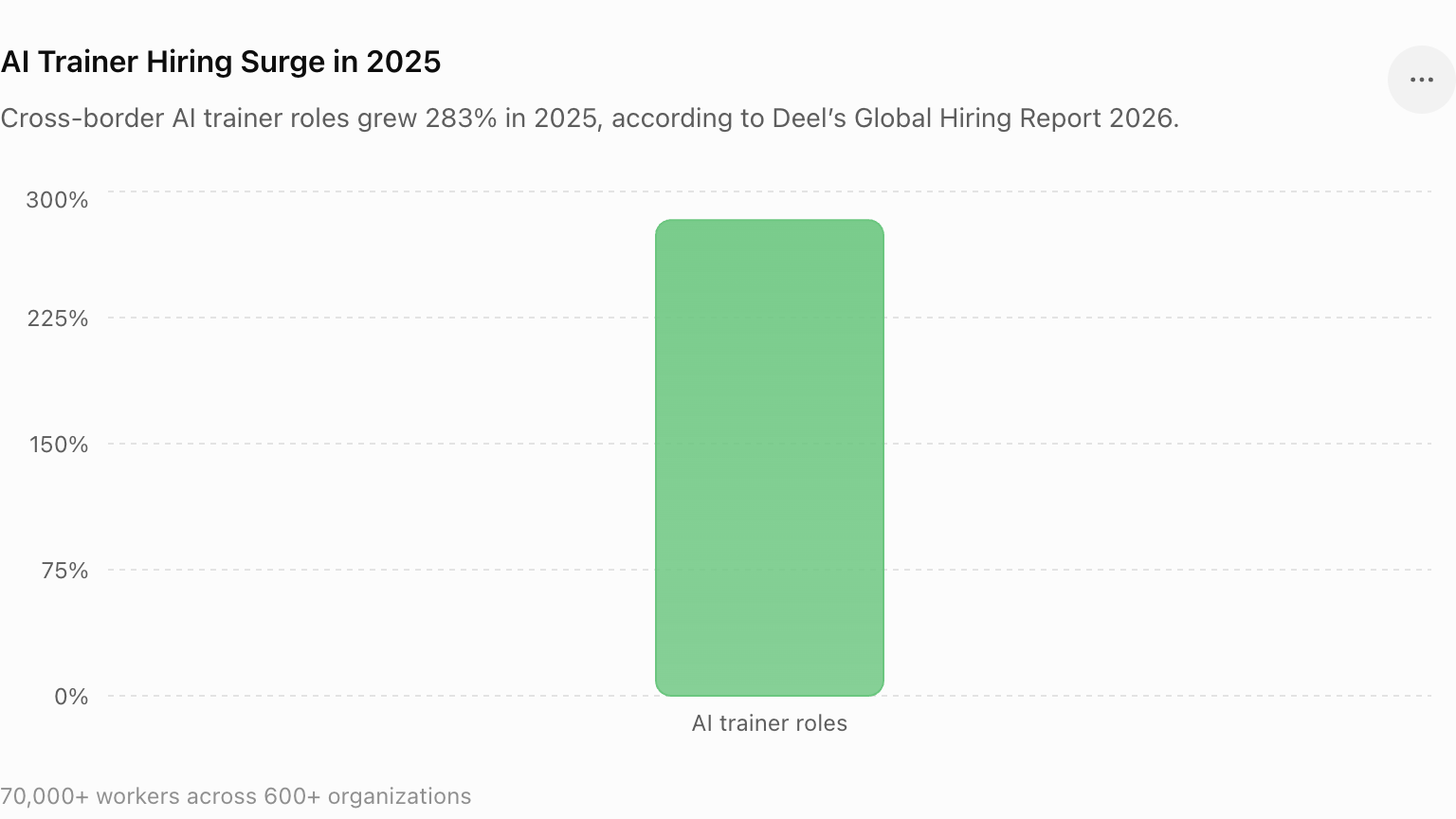
That matters even more in 2026. According to Deel’s latest global hiring data, AI trainer roles grew 283% in cross-border hiring in 2025, with more than 70,000 people now working in the field across 600+ organizations.
But finding talent is only half the job. Once a candidate accepts an offer, companies still need to manage contracts, local employment laws, payroll, benefits, taxes, and payments.
That’s where the next generation of global hiring workflows gets interesting.
Now, let’s dive into the full details.
AI Has Changed What Companies Look For in Global Talent
The global talent market is changing quickly.
Companies no longer need to focus their hiring only on people who live near their offices. AI is helping recruiters find the right skills, match candidates with suitable roles, and build teams across multiple countries.
The numbers show just how quickly this shift is happening.
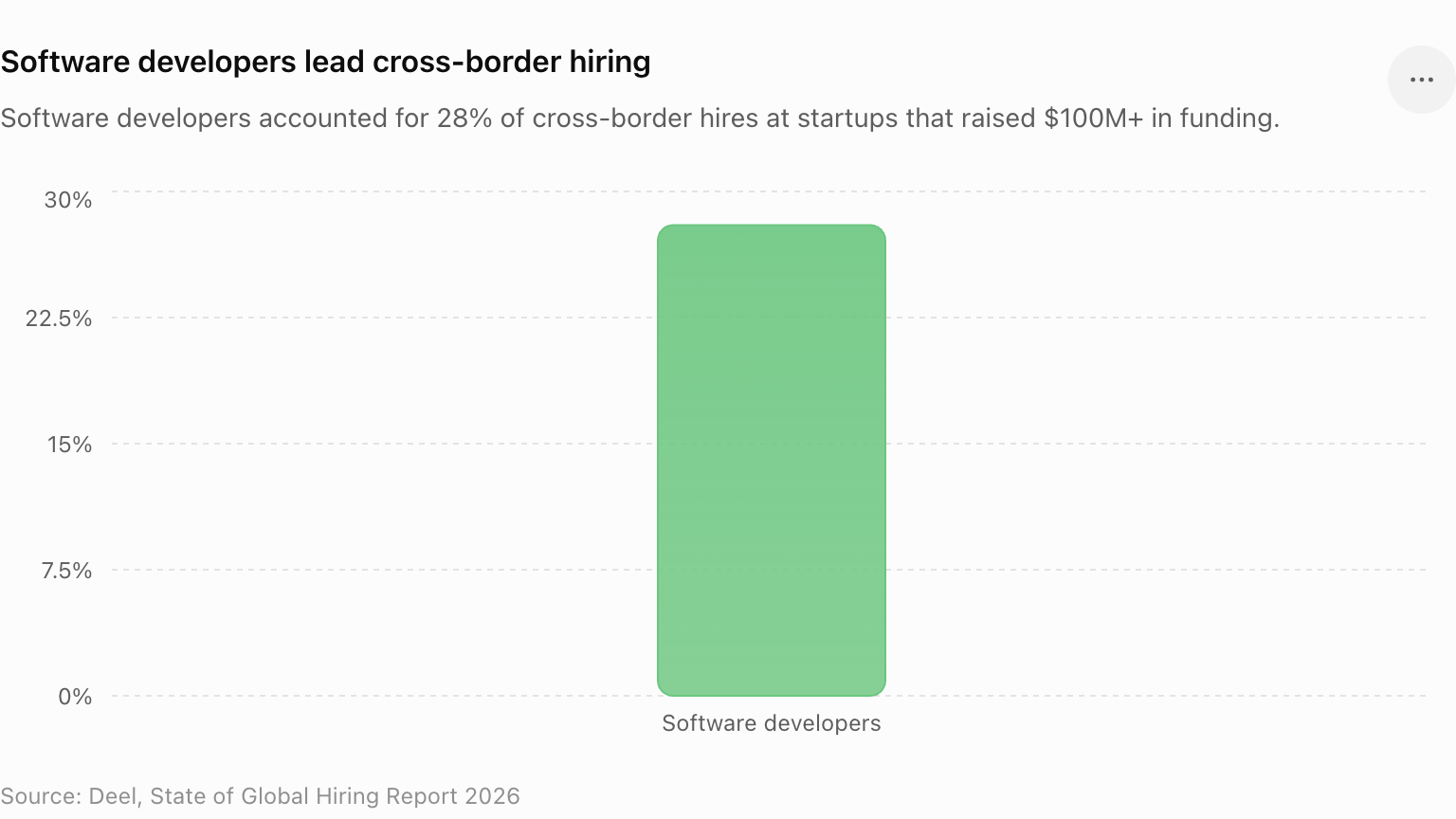
According to Deel’s latest global hiring data, software developers accounted for 28% of cross-border hires among startups that had raised more than $100 million, while AI-related roles are also growing rapidly, with hiring for AI trainers increasing 283% across borders in 2025 and more than 70,000 AI trainers now working across 600+ organizations.
That tells us something important.
Companies aren’t just hiring globally because overseas talent may cost less. They’re hiring because the right skills may be anywhere.
Skills are becoming more important than location
Consider a company building an AI product.
It might need a machine learning engineer in India, a product designer in Europe, a data specialist in Latin America, and an AI trainer somewhere else.
Ten years ago, managing a team spread across several countries could create a major workload for HR teams. Today, AI can help recruiters find candidates, evaluate skills, handle repetitive tasks, and keep the hiring process moving.
But finding the right candidate is only one part of global hiring.
After someone accepts an offer, the company still needs to employ them legally and manage contracts, local benefits, payroll, taxes, and payments based on the rules of their country.
That is where global hiring infrastructure becomes important.
A recruiter can use AI to find a strong candidate in another country, but the company still needs the right systems to employ and pay that person correctly.
So the new hiring model is not simply:
AI replaces traditional hiring.
It’s closer to:
AI accelerates the hiring process, while employment infrastructure manages the complexity behind the scenes.
As companies continue hiring specialized talent across borders, both parts of the process will become increasingly important.
The Global Hiring Workflow Is Becoming AI-Assisted
Look at what happens when a company decides it needs to hire someone overseas.
The old process can feel like a relay race. HR starts the process. Recruiting finds candidates. Legal checks the country rules. Finance works out the cost. Someone creates the contract. Payroll sets up payments. Then another person checks whether everything was done correctly.
AI is starting to connect those pieces.
1. Workforce planning starts with better data
Before a recruiter even posts a job, AI can help companies answer questions like:
- Where should we hire this role?
- What skills do we actually need?
- What might this hire cost?
- Do we need a full-time employee, contractor, or another employment structure?
This helps hiring teams have a more informed starting point, with less reliance on spreadsheets and assumptions.
2. Finding candidates takes less manual work
AI can scan large talent pools and help recruiters match candidates based on their skills, experience, and the requirements of a role.
This matters even more when companies hire across borders. The right candidate may live thousands of miles away from the company’s headquarters.
A recruiter who once focused on a single local market can now search a much larger talent pool.
3. Offers and onboarding become part of one workflow
Once a candidate accepts an offer, the hiring process does not have to stop at “Congratulations.”
AI can help prepare documents, start approval steps, collect employee information, and move the new hire into onboarding.
Deel’s AI-powered recruiting tools are a good example of how global hiring is changing. The company connects recruiting with onboarding, HR, and payroll, so information can move between these processes without being entered manually into different systems.
That is where AI-assisted hiring becomes more valuable.
The goal isn’t simply to complete one hiring task faster. It is to reduce the gaps between each step of the process.
4. Humans still make the important calls
This doesn’t mean recruiters are going away.
People still need to decide whether a candidate is the right fit for the role and the company. They need to evaluate judgment, communication, leadership, experience, and other qualities that technology can’t fully assess.
AI can take care of more repetitive work, while hiring teams can focus their time on decisions that require human judgment.
But there is an important catch: making the hiring process faster doesn’t eliminate the rules and requirements that come with employing someone in another country.
And that’s where the global hiring workflow gets much more interesting.
But AI Can’t Remove the Hardest Part of Global Hiring
Here’s the catch: finding the right person is only half the job.
AI can help recruiters find a developer in India, an AI trainer in Brazil, or a designer in Germany. It can rank candidates, write outreach messages, schedule interviews, and move approvals along.
But AI can’t erase the legal requirements that come with hiring across borders.
As soon as someone is employed in another country, a company may need to handle local employment laws, worker classification, contracts, statutory benefits, taxes, payroll, and termination rules.
And those rules aren’t the same everywhere.
That’s why AI-powered global hiring needs something less visible but just as important: strong employment infrastructure underneath it.
Think of it like an airport.
AI can help you find the best flight, compare routes, and get you to the gate faster. But you still need the runway, air traffic control, security checks, and systems that keep the whole thing operating safely.
Global hiring works in much the same way.
AI is becoming the fast-moving layer on top, while compliance, payroll, contracts, and employment infrastructure form the foundation underneath.
And as companies automate more of the hiring process, that foundation becomes even more important.
After all, there’s little value in cutting hiring time from five weeks to five days if the new employee can’t be onboarded, paid, or employed compliantly.
Why Compliance Becomes the Infrastructure Layer
When hiring crosses borders, companies cannot leave compliance until the end of the process.
They need to build it into the hiring workflow from the beginning.
Why? Because every country can bring its own rules for employment contracts, worker classification, taxes, benefits, payroll, working conditions, and termination.
A company might use AI to find the right candidate in minutes. But if the company doesn’t know how that person should legally be employed, the fast hiring process can quickly become a costly problem.
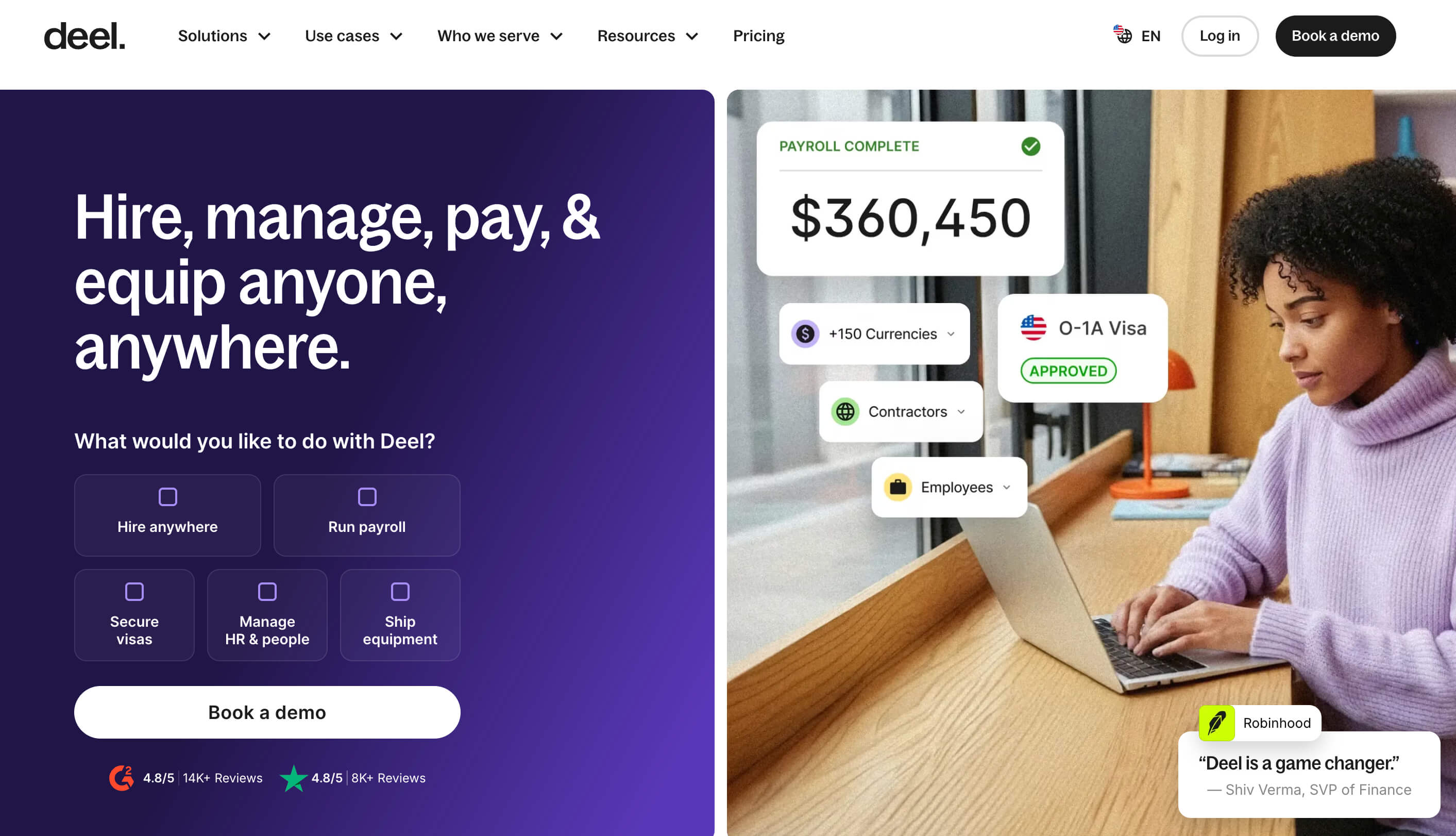
This is where a platform like Deel becomes part of the infrastructure.
<- See how Deel enables global hiring ->
The companies can bring compliance into the same workflow as hiring, contracts, onboarding, payroll, benefits, and workforce management. This keeps compliance tied to the actual employment process from the start.
This matters even more when a company hires across several countries.
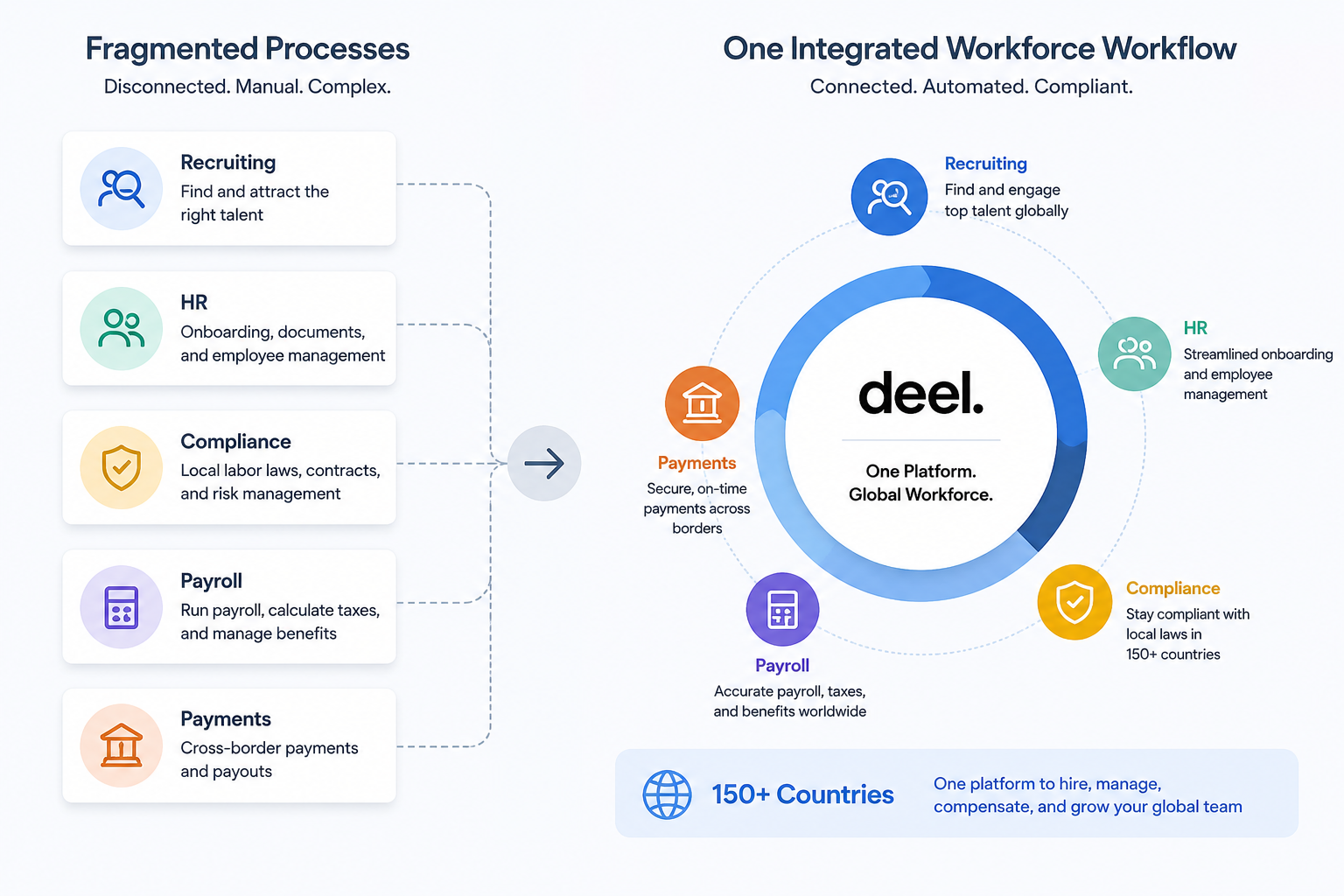
Deel says its platform supports workers and businesses across 150+ countries, bringing global HR, payroll, compliance, and employment services into one platform.
The main idea is this:
AI can help companies decide who to hire and automate many steps that follow. Employment infrastructure helps make sure the company can legally employ and pay that person.
And that’s why compliance isn’t just a legal checkbox anymore.
It is becoming a core part of the technology behind global hiring.
Payroll Is Where the AI Hiring Promise Meets Reality
Hiring someone is only the beginning.
Once a person joins the team, the company has to pay them correctly and on time while following the rules of the country where they work.
That’s where global payroll gets complicated.
Every country has its own tax system, currency, benefits, reporting requirements, and payment rules. Add dozens of employees across multiple countries, and a spreadsheet can start to feel more like a problem than a solution.
Global hiring data also shows that workers don’t always want to receive their pay in the currency used in their home country.
For example, Deel reported that 84.6% of Argentinian workers in its 2025 dataset chose to receive USD rather than Argentine pesos. The US dollar also appeared in five of the ten most common country-currency combinations in the report.
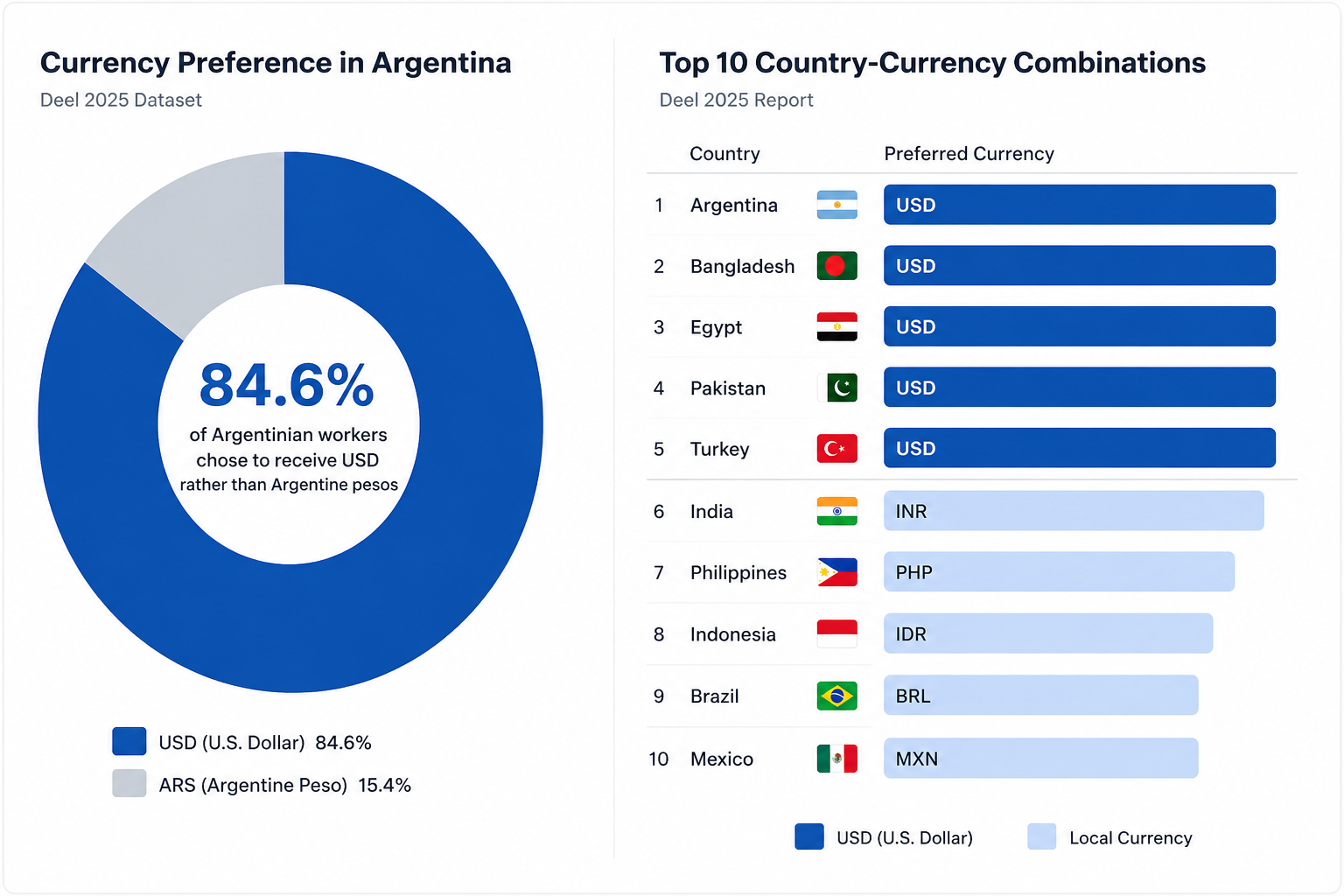
That tells us something important: global payroll isn’t simply about sending money.
Companies need reliable systems that can manage compensation across borders, while workers need payment options that match how they earn, save, and spend their money.
This is where AI can play an important role in payroll.
AI can detect unusual payroll activity, handle repetitive checks, find missing information, and start workflows based on specific conditions. But AI still depends on solid payroll infrastructure underneath it.
That infrastructure needs accurate country-specific rules, reliable worker data, payment systems, and strong compliance controls.
So the future isn’t AI replacing payroll infrastructure.
It’s AI helping payroll infrastructure handle more work with less manual effort.
As companies build more international teams, that combination could become a major advantage for businesses that hire across borders.
AI Agents Are Moving From “Helping HR” to Doing HR Workflows
For years, most HR software used AI as a helpful assistant.
You could ask a question and get an answer. You could ask it to draft an email or summarize a document.
That’s starting to change.
The next step is AI that can take action and move work through a workflow.
For example, when a new hire accepts an offer, an AI agent can help start the onboarding process, collect missing information, prepare the required documents, and send the right data to payroll.
That’s a major shift.
The value isn’t only about writing emails or completing tasks faster. AI can also reduce the manual work that happens between people, tools, and HR systems.
Deel has been moving in this direction too, with AI agents built around tasks across areas such as hiring, onboarding, payroll, IT, and compliance.
Why the infrastructure underneath matters
Here’s the catch.
An AI agent can only act on the information and systems available to it.
If an agent knows that a new employee is joining a company but doesn’t have reliable information about their country, employment structure, compensation, tax requirements, or payroll setup, it can’t safely complete the workflow.
That makes global employment infrastructure even more important as AI agents take on more HR work.
The AI agent acts on the work.
The underlying HR, compliance, payroll, and employment systems provide the data and rules it needs to act safely.
This also changes what companies should ask when evaluating HR technology.
Rather than asking, “Does this platform have AI?”
A better question is:
“What can the AI actually do, and which systems can it safely act on?”
That distinction will become more important as AI moves beyond answering HR questions and starts handling real parts of the global hiring workflow.
What a Modern Global Hiring Stack Looks Like in 2026
So, what does a modern global hiring setup look like when you bring all the pieces together?
It has three main layers that work together.
First, there’s the AI layer.
This is where companies can use AI for workforce planning, candidate sourcing, screening, recruiting workflows, onboarding tasks, and workforce insights.
Then there’s the employment infrastructure layer.
This is the part that handles the things AI can’t simply automate away: employment contracts, worker classification, local compliance, benefits, payroll, taxes, and payments.
And finally, there’s the human layer.
Recruiters, HR teams, managers, Finance, Legal, and employees still make the decisions that need context, judgment, and accountability.
The important part is that these layers shouldn’t operate like separate islands.
A hiring manager shouldn’t have to enter the same employee information into five different systems. HR shouldn’t have to chase Finance for every payroll detail. And a new hire shouldn’t have to complete the same paperwork again because the recruiting system can’t talk to the employment system.
That’s where platforms such as Deel are trying to change the model.
Rather than handling recruiting, HR, compliance, payroll, and payments as completely separate processes, Deel brings them into one global workforce workflow.
Its platform supports companies across 150+ countries and covers areas such as HR, payroll, compliance, and global employment.
The model is simple:
AI is the accelerator.
Employment infrastructure is the foundation.
People remain in control of the decisions.
Together, these layers make AI-powered global hiring more practical for real businesses, not just something that looks impressive in a demo.
What Companies Should Change in Their Hiring Workflows
If AI takes on more of the hiring process, companies need to rethink how the whole workflow works.
Simply adding an AI tool to an old process won’t fix much.
If recruiters still move information between systems, HR still checks every detail by hand, and Finance still waits for an email before payroll can start, the company has only automated one part of a broken process.
A better approach starts with the entire hiring journey.
Start with the workflow, not the tool
Look at each step from the moment a hiring manager gets approval for a new role to the moment the employee receives their first paycheck.
Then ask one simple question at each step:
Does a person really need to do this?
If the answer is no, that step may be a good candidate for automation.
AI can handle repetitive tasks such as matching candidates, preparing documents, checking data, sending reminders, and triggering the next step in a workflow.
But companies should not automate every decision.
Some areas still need human oversight, especially when they involve employment classification, compensation, sensitive employee data, or local employment laws.
Build compliance into the process
Compliance shouldn’t arrive at the end of the hiring workflow like an unpleasant surprise.
It should be considered before the offer is made.
That means understanding the worker’s location, employment structure, contract requirements, benefits, payroll obligations, and other local rules as part of the hiring process itself.
This is where global employment platforms become more valuable as AI takes on more hiring tasks.
When companies hire faster, they also need a way to handle compliance just as quickly.
Create one reliable source of workforce data
This may sound boring.
It isn’t.
When employee information sits across recruiting software, spreadsheets, payroll systems, HR platforms, and email threads, automation becomes harder to manage.
AI works best when it can access reliable data and follow defined rules.
A connected workforce system can reduce duplicate data entry and help HR, Finance, and managers work from the same employee information throughout the hiring and employment process.
Measure more than time-to-hire
AI makes it tempting to celebrate faster hiring.
But speed isn’t the only metric that matters.
Companies should also look at:
- How quickly new hires become fully onboarded
- Payroll accuracy
- Compliance issues
- Administrative workload
- Time spent on manual data entry
- Employee experience
- Cost of hiring across countries
Because a fast hiring process that creates payroll errors or compliance problems isn’t really fast.
It’s just moving the problem downstream.
The goal for 2026 isn’t simply to hire faster.
It’s to build a hiring workflow where AI removes unnecessary work while the underlying infrastructure keeps everything accurate, compliant, and connected.
The Competitive Advantage Is No Longer Just Hiring Faster
For years, the main goal in hiring was to hire as quickly as possible.
Post the job. Find candidates. Make an offer. Get someone through the door.
AI is changing that equation.
When software can help companies find candidates faster and automate much of the administrative work, simply being faster stops being a big competitive advantage.
The bigger advantage is access.
A company that can confidently hire a specialist in another country has a much larger talent pool than one restricted to its local market.
Deel’s hiring data points in that direction. Its report shows that highly funded startups are hiring globally for specialized roles, with software developers accounting for 28% of cross-border hires among startups that raised more than $100 million.
That’s important because global hiring isn’t just about lowering labour costs.
It’s about finding people with skills that may be hard to find locally.
AI makes that search easier.
Global employment infrastructure makes acting on that opportunity possible.
Put the two together, and a company can move from:
“Who can we hire near us?”
to:
“Who is the best person for this job, wherever they are?”
That is a much bigger shift than simply hiring faster.
And it changes the role of HR, too.
HR teams don’t have to spend as much time pushing information between systems or manually coordinating every administrative step. They can spend more time on workforce strategy, employee experience, leadership, and the decisions that actually need a human.
The companies that benefit most won’t necessarily be the ones with the most AI tools.
They’ll be the ones that connect AI, people, data, compliance, and payroll into one working system.
What AI-Powered Global Hiring Could Look Like Next
The next phase of global hiring won’t feel like one giant leap.
It’ll happen quietly, one workflow at a time.
A hiring manager approves a new role. AI helps define the skills needed and suggests where the company could find that talent.
Recruiting tools identify potential candidates and help move the strongest ones through the process.
Once someone accepts, the employment workflow kicks in.
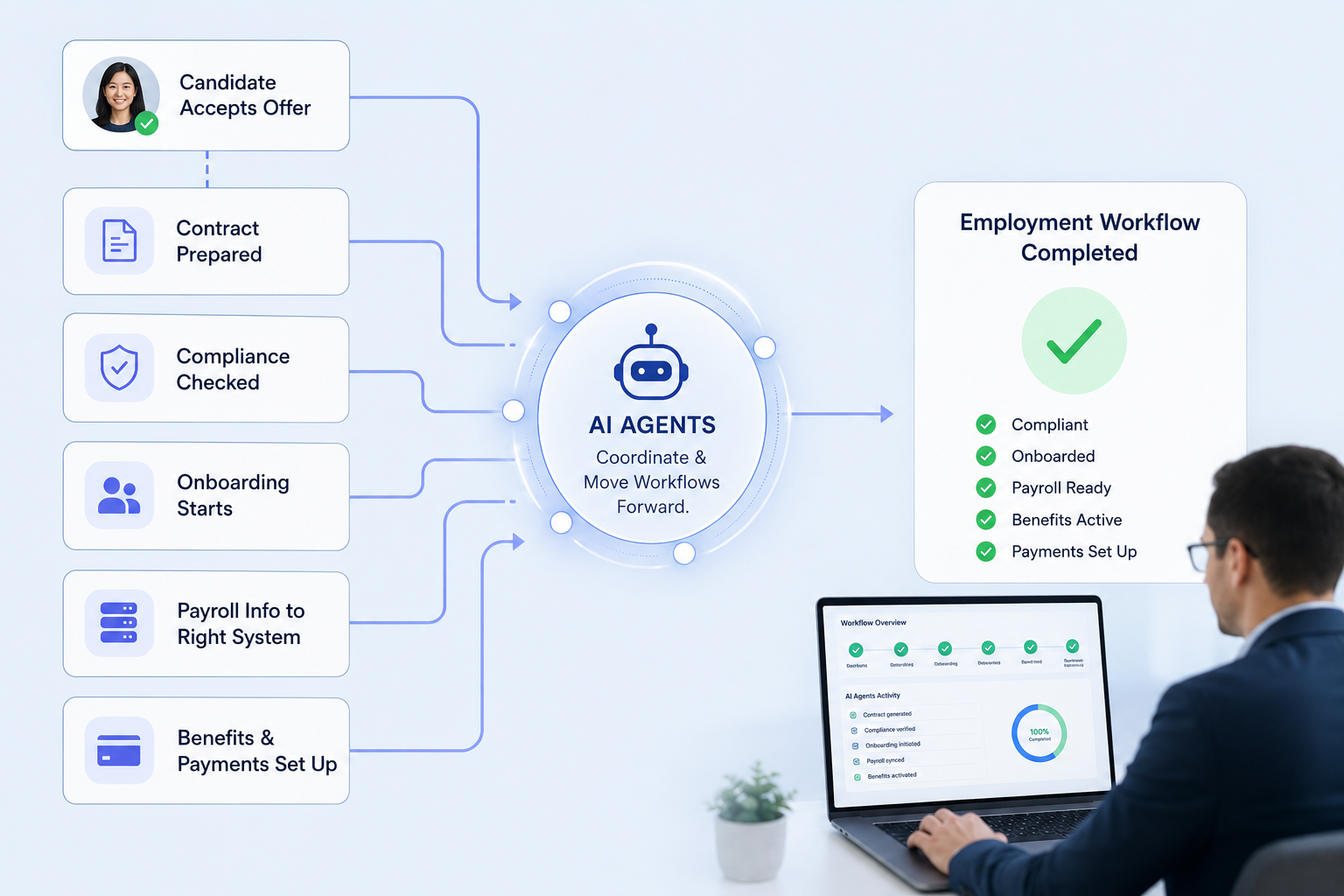
The right contract is prepared. Compliance requirements are checked. Onboarding starts. Payroll information flows into the right system. Benefits and payments are set up.
And instead of someone manually pushing each task forward, AI agents can increasingly coordinate parts of that process.
That’s where the real opportunity sits.
The future isn’t about replacing every person involved in hiring. It’s about removing the work that never needed a person’s full attention in the first place.
A recruiter shouldn’t have to spend hours copying candidate information from one system to another.
An HR manager shouldn’t have to manually check the same country rules every time a company hires in a familiar market.
Finance shouldn’t have to rebuild payroll information from scratch after every new hire.
And employees shouldn’t have to wonder whether their contract, benefits, or first paycheck will arrive correctly.
The ideal workflow looks more like this:
AI handles the repetitive work.
Employment infrastructure handles the complexity.
People handle the judgment.
This model could transform global hiring from a collection of separate processes into one connected workforce system.
And that’s the real promise of AI in global hiring.
It’s not simply about doing things faster.
It’s about helping companies build global teams with less friction while keeping the human oversight and compliance safeguards that still matter.
FAQs About AI and Global Hiring in 2026
How is AI changing global hiring?
AI is helping companies automate parts of the hiring process, from workforce planning and candidate sourcing to screening, onboarding, and administrative workflows. The biggest change is that AI can connect more steps in the process instead of simply helping with one task at a time.
Can AI automate international hiring?
AI can automate many repetitive parts of international hiring, but it can’t remove the need for human oversight or local employment requirements. Companies still need to handle contracts, worker classification, payroll, benefits, taxes, and country-specific compliance.
Why is compliance important in AI-powered hiring?
Because hiring someone in another country creates legal and financial responsibilities. A company can find and select a candidate with AI in minutes, but that person still needs to be employed under the appropriate rules for their location.
What role does payroll play in global hiring?
Payroll turns a successful hire into an actual working relationship. Companies need to calculate and process compensation correctly while dealing with local taxes, currencies, benefits, and payment requirements. As teams expand across countries, they need payroll systems that work together and keep these processes organized.
Can AI replace recruiters?
Not completely. AI can take over repetitive tasks and help recruiters work through larger talent pools, but people still need to assess candidates, build relationships, make hiring decisions, and understand the needs of the business.
What is the role of an Employer of Record in AI-powered hiring?
An Employer of Record can provide an employment structure for companies hiring workers in countries where they don’t have their own legal entity. This can help companies manage local employment requirements while their internal teams focus on hiring and managing the person.
How can companies reduce risk when hiring internationally?
Start by building compliance into the hiring process from the beginning, not after the candidate accepts the offer. Use accurate workforce data, set clear approval steps, and make sure contracts, payroll, benefits, and local employment rules are handled correctly for each worker’s location.
What should companies automate first?
Start with repetitive, rules-based tasks that take up time but need little human judgment. Candidate administration, document collection, workflow notifications, data entry, onboarding tasks, and payroll checks are all good places to start.
The goal isn’t to automate everything.
It’s to reduce the amount of manual coordination people have to handle, so they can focus on work that needs their experience, judgment, and attention.
Final Thoughts
AI is changing global hiring.
Companies can find talent faster, handle repetitive recruiting tasks, and build teams across borders without depending so much on slow, manual processes.
But AI can only take hiring so far.
Hiring someone is about more than finding the right candidate. The company still needs the right contract, proper employment setup, accurate payroll, benefits, tax handling, and reliable payments. It also needs to follow the employment rules in the country where the person works.
That’s why the future of global hiring isn’t about AI replacing HR.
It’s about AI handling more of the repetitive work while employment infrastructure takes care of the complex work behind the scenes.
Deel is a good example of this model. Its AI-powered tools support the hiring process, while its global HR, compliance, payroll, and employment infrastructure help companies manage everything that comes after the hire.

Deel
★★★★★ (5 out of 5)
And that’s the real opportunity in 2026.
AI can help companies find and hire talent almost anywhere. Strong infrastructure helps them employ that talent responsibly and stay on top of the requirements that come with global employment.
Companies that connect both will be in a much stronger position to build global teams around skills, not just location.
And that’s it.
I hope you liked our post on how AI is transforming global hiring workflows in 2026.
If you’re looking to hire, onboard, manage, and pay talent across borders, visit Deel to learn more about its global employment, HR, compliance, and payroll solutions.