For a long time, marketing automation claimed it would save time. In reality, it pushed marketers into building complex workflows and thinking like engineers.
Instead of focusing on growth and ideas, people spent hours setting up rules, triggers, and endless sequences.
ActiveCampaign looked at this problem and took a different approach. Rather than asking users to map every step, the platform now takes on much of the work itself. You start by stating what you want to achieve, and the system takes it from there.
This change shifts the focus away from building logic chains. AI agents take over the planning, execution, and performance tracking.
They run campaigns, monitor results, and handle repetitive tasks in the background. That leaves you with more time to focus on creative thinking and decision-making.
Where Marketing Goes Next
Marketing is moving in a new direction. Autonomous marketing isn’t just another feature. It’s a mindset that shapes how platforms like ActiveCampaign build and evolve their products.
ActiveCampaign is leading this shift by creating AI agents that go beyond basic support. These agents work alongside you, handling repetitive and time-consuming tasks that most marketers would rather avoid. Instead of just completing actions, they free up your time so you can focus on ideas, planning, and creative work.
And the impact is real. Their research shows that AI helps marketers save around 13 hours every week on average.
Beyond Automation – Why ActiveCampaign Is Building What Comes Next in Marketing
ActiveCampaign is putting serious focus on what comes next in marketing, and it comes down to one thing: helping marketers get their time back.
Right now, most marketing teams feel stretched. Budgets face constant scrutiny, but expectations keep rising. You’re expected to deliver more personalization, better results, and faster execution, often with the same or fewer resources.
Autonomous marketing shifts how marketers work. Instead of spending hours managing tools and workflows, you move back into a more strategic role. The system handles execution and ongoing improvements, so you can focus on ideas, direction, and growth.
Let’s break it down from the basics.
What Does Autonomous Marketing Actually Mean?
Autonomous marketing is an AI-driven approach where intelligent agents handle strategy, content creation, execution, and optimization on their own. You don’t need to build workflows or manage every step manually.
Traditional automation still depends on constant input and supervision. Autonomous marketing works differently. It runs on its own once you define your goals.
It also relies on conversational AI. You interact with the platform the same way you would talk to tools like ChatGPT or Claude. You explain what you want to achieve, and the system builds and runs the campaigns for you.
It’s the difference between programming a machine and working with a partner.
With traditional automation, you map out every rule: “If this happens, do that.”
With autonomous marketing, you say, “This is my goal,” and the system figures out how to get there while continuing to improve performance along the way.
Key Differences
- Traditional automation: You build workflows step by step. Every action, condition, and outcome needs manual setup.
- Autonomous marketing: You don’t build campaigns manually. You describe your goal in plain language, and the system handles execution, optimization, and ongoing changes.
- AI-assisted tools: These tools help with individual tasks. You provide a prompt, and they return an output. They don’t manage the full process or act independently.
In short, this shift moves marketers away from managing tools and toward leading outcomes.
The marketing automation industry is projected to hit $15.7 billion by 2027, showing just how fast companies are investing in smarter systems.
Active Intelligence – The Core of Autonomous Marketing
Active Intelligence runs the entire system. It brings together advanced AI and automation and puts them to work across your marketing. It powers everything you see, from automations and conversational tools to AI agents and performance insights.
You can think of it as the central system that directs all your AI agents. It drives every stage of autonomous marketing, from planning campaigns to launching them and checking results.
Active Intelligence relies on:
- Large volumes of campaign data collected across industries and regions
- Machine learning models that learn how your business, audience, and market behave
- Specialized AI agents built for specific marketing tasks
- A conversational interface that lets you manage everything using simple instructions
With this setup, you can create personalized experiences, write content that matches your brand voice, reach the right audience at the right time, and track real business results without getting buried in manual work.
How Active Intelligence Operates
Active Intelligence acts like a marketing co-pilot that works alongside you. You simply tell it what you want to achieve, such as:
- “Create a welcome series for new customers”
- “Find my highest-value audience segments”
From there, it pulls in the right AI agents and handles the execution.
It doesn’t just run tasks. It also helps you understand what’s happening inside your campaigns. You get suggestions, insights, and feedback while you work, so you can improve results as you go.
There’s also a sidebar that stays with you across the platform. It works like an assistant that’s always available. While you build or review a campaign, it can suggest improvements, highlight issues, and point out opportunities based on your current work.
How Active Intelligence and AI Agents Work Together
Active Intelligence acts as the brain, while AI agents act as specialists.
It understands your goals, your business context, and your audience. Then it assigns the right agents to handle specific tasks like:
- Building campaigns
- Analyzing audiences
- Writing content
- Improving performance
- Validating results
Each agent focuses on its role, but all of them run on the same intelligence layer.
Personalization
Active Intelligence learns from your data, your industry, and how your customers behave. Because of this, every campaign feels personal, even when you’re reaching a large audience.
AI agents shift your marketing from manual task handling to proactive execution. Instead of reacting to what’s happening, you stay ahead with campaigns that run with purpose and direction
Next, let’s look at the individual AI agents and what each one does.
What are AI Agents?
AI agents do more than just help with small tasks; they handle entire marketing functions from start to finish. Most software forces you to learn complex menus and build every automation step-by-step. AI agents are different. They recognize your business goals and execute full workflows based on a simple prompt, removing the technical hurdles that usually slow you down.
Types of AI Agents
1. AI Agents That Help You Come Up With Ideas
These agents turn your ideas into real campaigns. You can share a concept, and they build content, campaigns, and insights around it.
How they work:
They don’t stop at writing content. They build full campaigns with messaging that fits your brand, create visuals, and uncover audience segments you might have missed.
For example, they can:
- Create campaigns in multiple languages while keeping your brand voice intact
- Analyze your customer data and highlight high-value audience groups
- Turn raw ideas into ready-to-use marketing assets
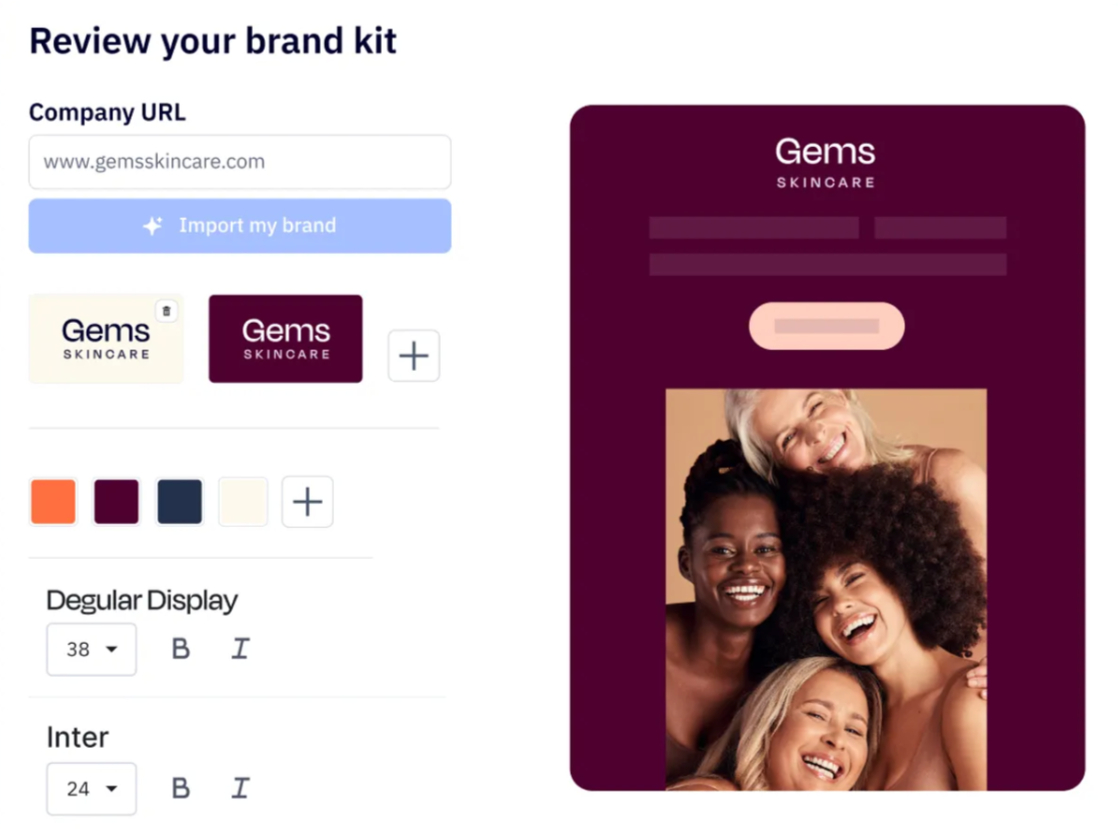
The AI Brand Kit pulls in your logo, fonts, and colours so everything stays consistent. It takes only a few minutes to set up.
You can also use them for things like campaign creation or identifying your most valuable customer segments through data.
2. AI Agents That Launch Your Campaigns
These agents take your plan and turn it into action. They build workflows, connect tools, and run your campaigns without manual effort.
How they work:
They set up multi-step automations, recommend proven approaches based on your business, and help create tailored customer experiences.
For example, they can:
- Build a welcome email series for new subscribers
- Create detailed automation flows with personalized messaging
- Handle the full setup of your campaign execution
They take your idea and carry it through to real execution.
3. AI Agents That Track and Improve Results
These agents focus on performance. They study your campaigns, predict outcomes, and keep improving results over time.
How they work:
They monitor what works and what doesn’t, track your progress, and share insights when you need them.
For example, they can:
- Predict the best time to send messages
- Track your goals and show progress
- Suggest next steps based on performance data
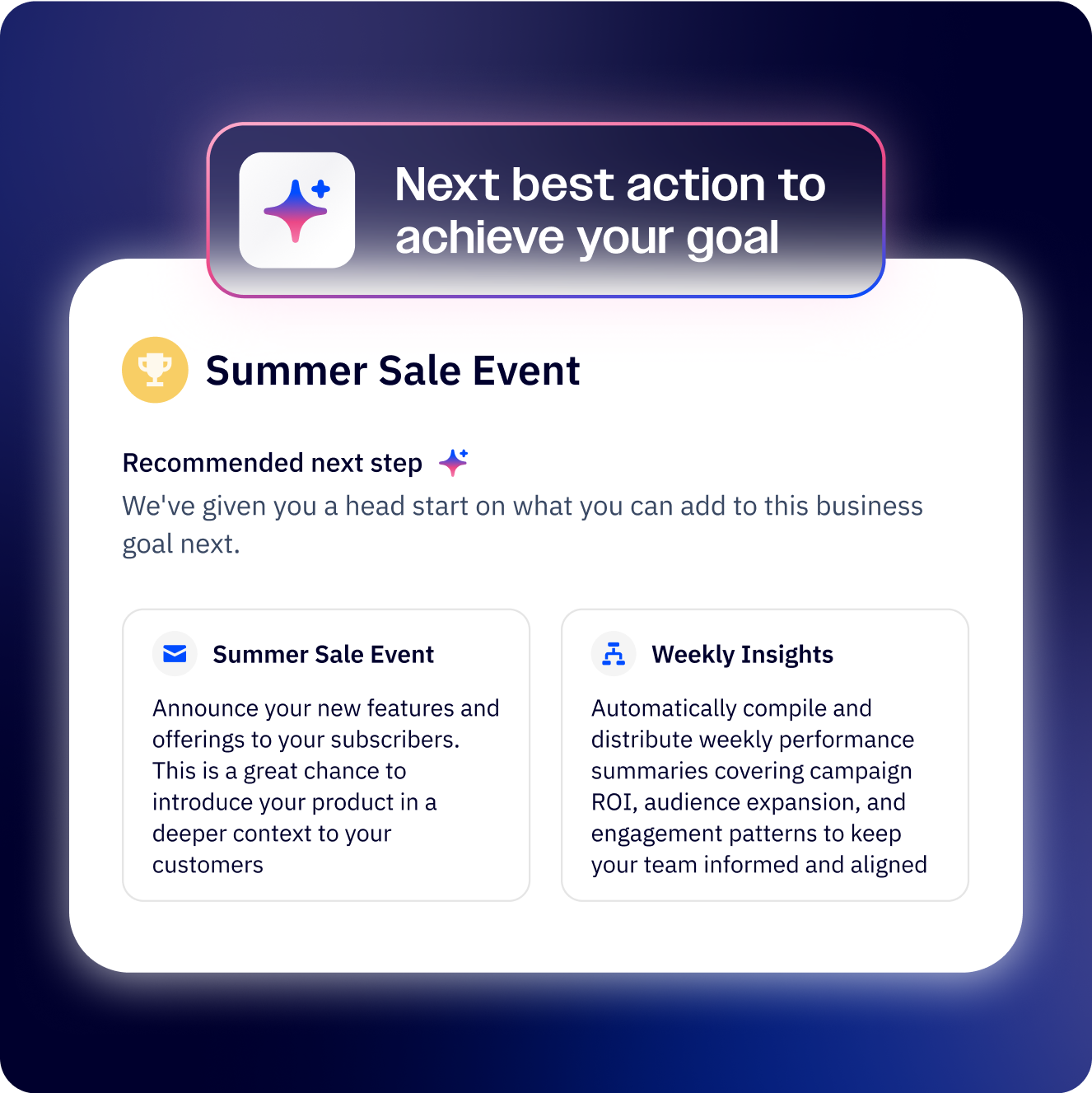
ActiveCampaign’s Business Goals feature helps you stay focused and shows what actions to take next.
These agents don’t just report results. They keep improving them.
AI Agents vs Traditional AI Tools
Traditional AI tools help you complete small tasks.
AI agents handle the entire process.
For example:
- A traditional tool: “Help me write an email.”
- An AI agent: “Create a 7-day email sequence for new subscribers.”
The agent builds everything—content, timing, automation, and personalization.
This means even a solo marketer can run campaigns that once needed a full team.
8 Myths About Autonomous Marketing
If you feel hesitant about AI, that makes sense. There is a lot of noise out there. Let’s look at the facts.
Myth 1: AI is a future problem. It’s already here. 97% of marketers say AI has changed their daily work. The shift has happened; the goal now is to lead it.
Myth 2: I don’t have time to learn it. Marketers using AI save about 13 hours every week and over $4,000 a month. Using these tools gives you back a full day of work every week. Ignoring it costs you both time and money.
Myth 3: I’m too far behind. Most people are still figuring it out. ActiveCampaign’s research shows 34% of marketers are at an intermediate level, while only 15% consider themselves experts. There is plenty of room to grow.
Myth 4: AI kills creativity. It actually does the opposite. By handling technical setup and data tracking, AI frees you to focus on brand storytelling and human psychology—the parts of marketing that actually require a person.
Myth 5: It sounds like a robot. AI learns your specific voice. It uses your past successful content to make sure every new message sounds like your brand, often resulting in more personalized communication than a human could manage alone.
Myth 6: Nobody trusts AI content. Results earn trust. Small businesses using AI report that they can now compete with massive corporations because their campaigns launch faster and convert better. 74% of small firms say AI makes them more effective.
Myth 7: I still have to check the work. Reviewing a campaign that is 80% finished takes minutes. Building that same campaign from a blank page takes hours. You move from “builder” to “editor-in-chief.”
Myth 8: It will hurt my career. Leaders want people who deliver results. Mastering these tools makes you a strategic asset. You become the person who can do more with less, which is exactly what companies value most.
The Verdict
AI doesn’t replace marketers. It changes how you work.
It takes over repetitive tasks and lets you focus on bigger decisions, creativity, and growth. Once you start using it, the goal shifts from doing everything manually to guiding systems that can handle the heavy work for you.
If you’ve been unsure about AI, the best way forward is simple: start using it and see what it can actually do in your day-to-day work.
Meet Your ActiveCampaign AI Agents – The Future of Autonomous Marketing
ActiveCampaign provides a suite of AI agents that function as specialized experts within your marketing department. These agents collaborate to build and run unified campaigns across email, SMS, and WhatsApp.
Here is how each agent handles specific parts of your workflow.
Agents for Creative Production and Personalization
- AI Brand Kit: This tool grabs your colors, fonts, logos, and social links directly from your website. It ensures every message you send matches your brand identity without manual setup.
- AI Campaign Builder: You provide one prompt, and the agent builds a full email campaign. It writes the subject lines, organizes the layout, and places the images and calls to action.
- AI Content Generation: Use conversational prompts to write or rewrite email copy. It helps you move past a blank page to produce text that speaks to your audience.
- AI Image Generation: This agent creates original visuals for your emails. You get high-quality graphics tailored to your message without hiring a designer.
- AI SMS Builder: Enter a few details about your goal to generate text messages tailored for mobile screens.
- Active Intelligence Workspace (Campaigns): Tell this workspace what you want to achieve. It generates high-performing campaigns with messaging intended to drive results.
- AI Translations: This tool converts one email into versions for over 75 languages. It maintains your specific personality and tone while reaching customers in their own language.
- AI-Suggested Segments: The AI examines customer data to find specific groups, such as likely repeat buyers or subscribers who might leave. It identifies these opportunities so you can target them immediately.
- AI Actions Library: These are the components you use to build custom agents. Use them to identify customer intent, organize data, and personalize content for every individual.
Agents for Execution and Sales
- AI-Suggested Automations: Based on your specific business and audience, this agent recommends automation structures that have worked for others.
- AI-Suggested Actions: The AI looks at your active automations and identifies exactly which step you should take next to improve your results.
- Active Intelligence Workspace (Automations): State your objective to receive a complete, multi-step workflow. It builds the entire sequence, including the content for every stage.
Agents for Performance and Insights
- AI Campaign Calendar: This tool manages your schedule. It uses data-driven timing to make sure your messages arrive when they are most likely to be seen. (ActiveCampaign data shows: 3x faster campaign building, 15 days saved from idea to launch.)
- Predictive Sending: Every contact has different habits. This agent sends your message at the specific time each person is most likely to open it. (ActiveCampaign data shows: Predictive Sending increases CTR by 17% on average.)
- Active Intelligence Workspace (Insights): Ask questions about your performance or KPIs. The workspace provides summaries, charts, and specific steps to take based on your data.
- Business Goals: These agents track your progress toward specific targets. They monitor every update and offer recommendations to help you hit your numbers.
ActiveCampaign – The New Era of Autonomous Marketing
ActiveCampaign positions autonomous marketing as a new benchmark for how marketing should work. AI and integrations shouldn’t feel like add-ons you force into your stack, and powerful AI shouldn’t stay locked inside narrow use cases. Real autonomous marketing comes from a fully connected system where everything works together. That’s the approach behind the platform.
ActiveCampaign has also taken a big step forward by becoming the first autonomous marketing platform to integrate Anthropic Claude. This adds another layer of intelligence to how campaigns run and optimize themselves.
Now that the AI agents are on the table, the next step is understanding how they work together within a practical framework.
The High-Performance Marketing Triad
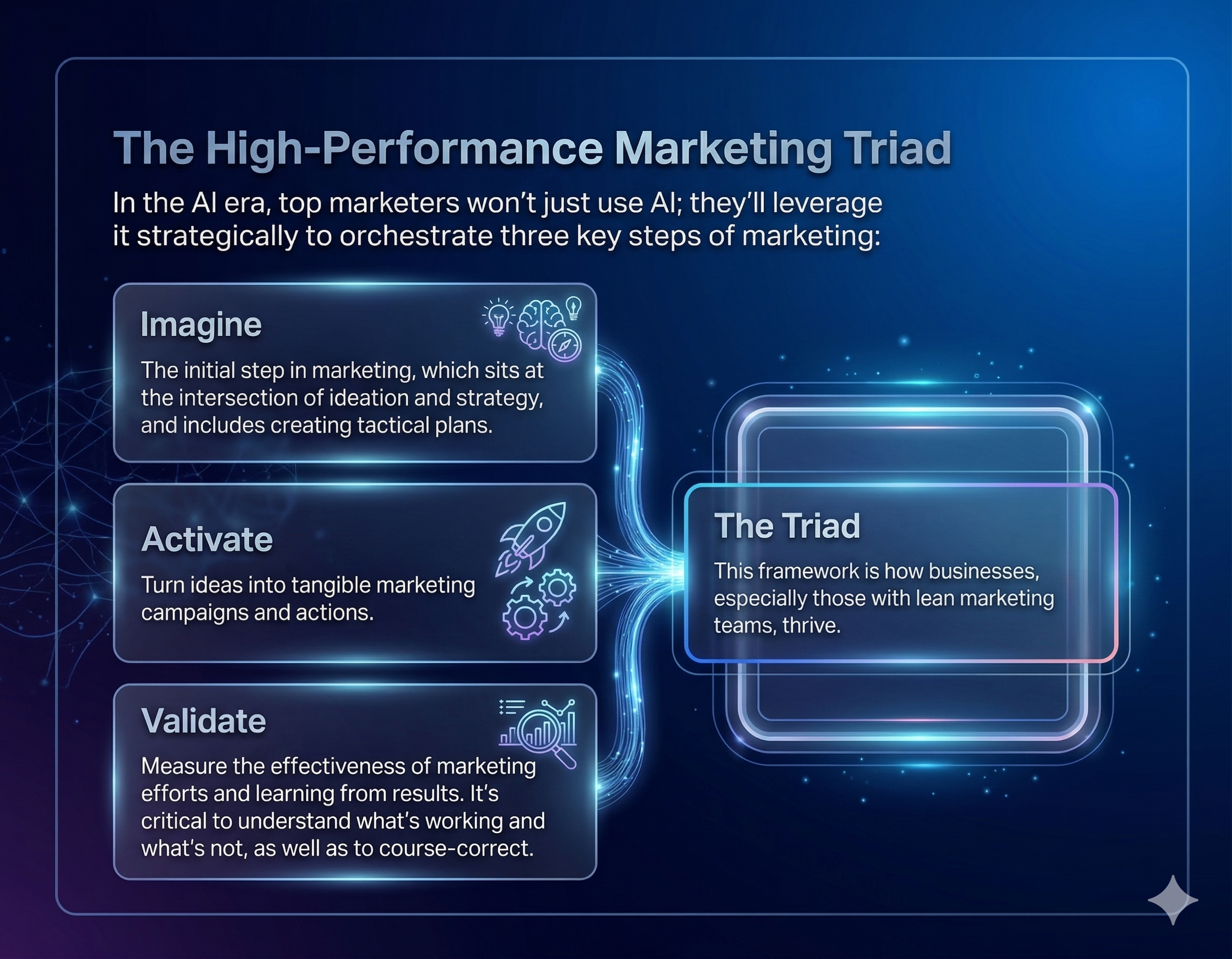
Top marketers don’t work in isolation. They move through three core phases again and again. Together, these phases form what ActiveCampaign calls the High-Performance Marketing Triad:
1. Imagine: Autonomous Execution
This is where planning happens. You explore campaign ideas, study your audience, and decide who to target. It also includes setting goals and shaping the message behind each campaign. Typical tasks include:
- Creating campaign concepts
- Identifying audience segments
- Defining goals
- Building messaging plans
2. Activate: Predictive Intelligence
This is where plans turn into live campaigns. You create content, build automations, and launch everything. It also covers tailoring messages for different audiences and timing your sends. Key tasks include:
- Writing emails and creating visuals
- Setting up automations
- Scheduling campaigns
- Personalizing content
- Managing send timing
3. Validate: Scalable Personalization
This phase focuses on results. You track performance and use the data to improve future campaigns. It includes:
- Reviewing open rates and clicks
- Measuring return on investment
- Comparing results with goals
- Identifying what worked and what didn’t
I made this image with Gemini.
Why All Three Matter
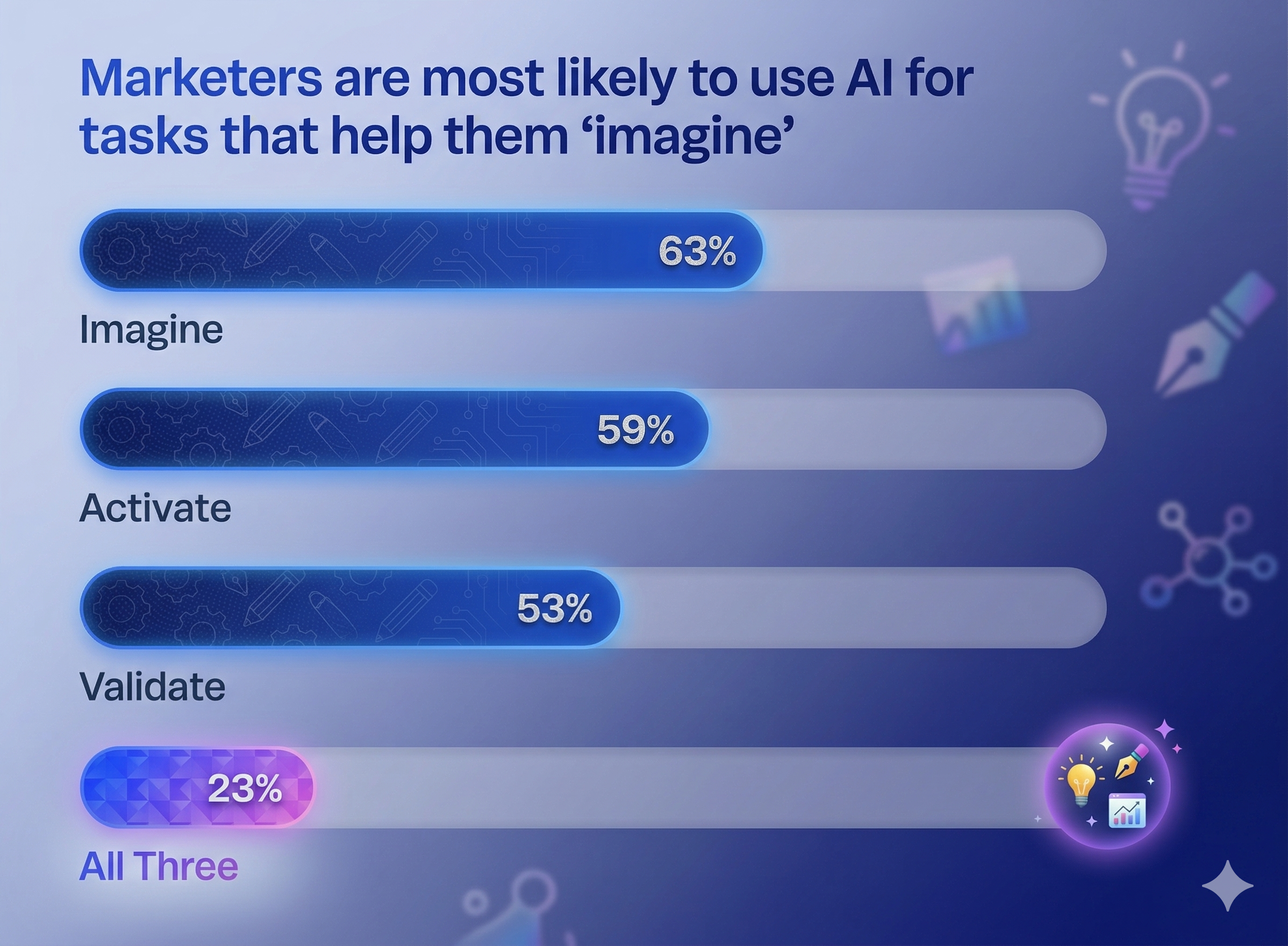
A recent survey of 1,000 marketers shows an interesting gap. While 82% already use AI, only 23% apply it across all three parts of this cycle. Most focus heavily on planning (63%) and ignore the rest.
That creates a missed opportunity.
If you only use AI for ideas, you leave time and money on the table. The real value shows up when AI supports execution and analysis too.
Think about it this way:
- Planning without Execution leads to great ideas that never launch.
- Execution without Verification means you are flying blind, never knowing if your budget is actually working.
- Verification without Planning means you are staring at the past instead of building the future.
When you use all three phases together, they form a loop. Each campaign improves the next one. AI doesn’t just help you come up with ideas. It helps you launch faster, measure results better, and use that data to improve what comes next.
That loop separates average marketers from the ones who consistently perform well.
I made this image with Gemini.
The ROI of Full Integration
Marketers who use AI across all three phases see stronger outcomes:
- They are 14.5 times more likely to use AI across their entire workflow
- They save 57% more time each week (14.8 hours vs 9.4 hours)
- They reduce costs by 36% ($5,299 vs $3,895 per month)
- They report twice the confidence in the quality of their work
- Around 68% of top-performing businesses already rely heavily on automation to run their marketing, and it’s not just about saving time. Businesses using automation have seen up to a 451% increase in qualified leads.
This consistent loop of planning, execution, and analysis creates momentum. Each campaign builds on the last one, leading to better outcomes over time.
How AI Agents Fit Into The I-A-V Framework
Most marketers don’t get strong results by using AI tools here and there. The real impact shows up when you use them across your entire marketing cycle with a clear structure. That’s where ActiveCampaign’s AI agents come in. Each one plays a specific role, and together they cover your full workflow from start to finish.
Here’s how these AI agents work across the High-Performance Marketing Triad:
IMAGINE (Planning and Ideation)
This stage focuses on planning campaigns and shaping your direction.
- AI Campaign Builder helps you create full campaign ideas from a simple prompt.
- AI Brand Kit keeps your messaging and visuals consistent everywhere.
- AI Content & Image Generation produces campaign copy and visuals based on your goals.
- AI-Suggested Segments uncovers new audience groups hidden in your data.
- Business Goals lets you define and track what you want to achieve.
ACTIVATE (Execution and Delivery)
This is where campaigns go live and start working.
- AI-Suggested Automations runs proven campaign flows without manual setup.
- Predictive Sending chooses the best time to reach each contact.
- AI Translations helps you launch campaigns in over 75 languages.
- AI Actions Library personalizes interactions using behaviour and logic.
- AI Campaign Calendar keeps your campaigns organized across channels and timelines.
VALIDATE (Analysis and Improvement)
This stage focuses on learning from results and improving performance.
- Active Intelligence: Insights turns raw data into useful answers through conversation.
- Business Goals tracks your progress and recommends next steps.
- Active Intelligence: Campaigns improves campaigns based on live performance data.
- Active Intelligence: Automations strengthen workflows using real user behaviour.
- Advanced Analytics compares your results with industry benchmarks.
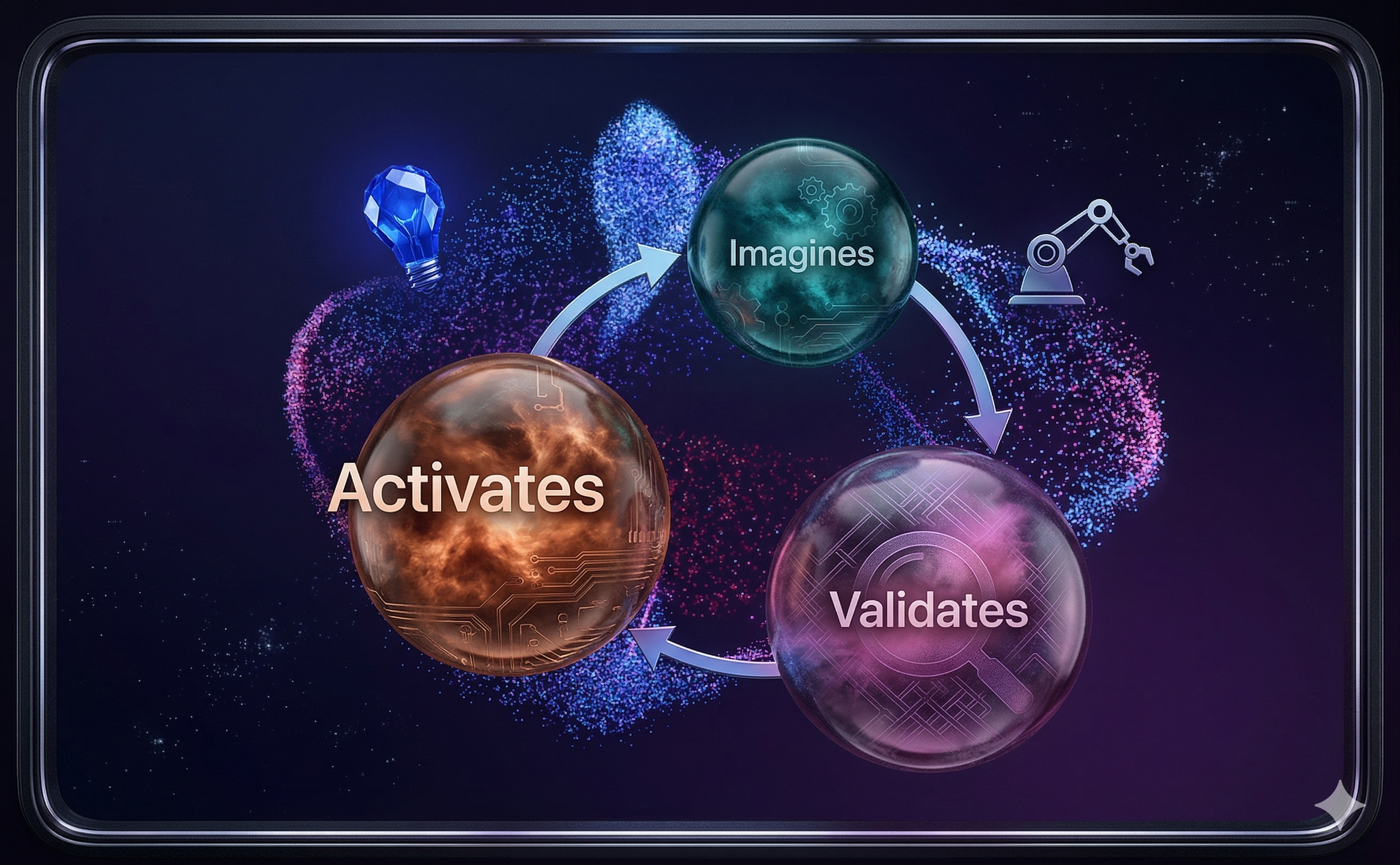
I made this image with Gemini.
How does it all work together?
The real value comes from using all three stages together, not separately. You set clear goals in the planning phase. AI agents then run and personalize your campaigns. After that, performance data feeds back into your next round of decisions.
This creates a continuous loop:
- Plan what to do
- Run campaigns automatically
- Learn from the results
Over time, this loop keeps improving how your marketing performs. Every campaign adds new data, and that data helps guide what you do next.
Real-World Impact – How Leading Brands Scale with Autonomous Marketing
One thing I always look for before trusting any marketing platform is real-world proof. Not features. Not promises. Actual results from businesses using it day to day.
And this is where ActiveCampaign starts to get interesting.
1. Scaling Revenue Without Burning Out the Team
As companies grow, communication quickly becomes messy. What used to work manually just stops working.
That’s exactly what happened with Kommunicate.
“As we were growing, it became almost impossible to manage communication and growth manually. That’s when we realized we needed automation, and that’s where ActiveCampaign came in. 66% of revenue year on year is likely driven by ActiveCampaign automation.” — Manab Boruah, Product Marketing Manager, Kommunicate
Results:
- 66% quarterly revenue growth
- 1.5x increase in conversions
- 24% email open rates
Instead of chasing every lead manually, their system now handles engagement and follow-ups automatically. That shift alone made a massive impact on revenue.
2. Doubling Conversion Rates With Smarter Nurturing
A lot of businesses struggle with turning trials into paying customers. The gap between interest and action is where most leads drop off.
Motrain tackled this by focusing on better nurturing instead of just more traffic.
“We’re tracking trials started and trial conversions, and right now we’re converting at over 20%. Before ActiveCampaign, we were converting less than 10%. ActiveCampaign has doubled our conversion rate.” — Nathan Monk, Co-Founder, Motrain
Results:
- Conversion rate doubled (from <10% to 20%+)
- More structured and effective multi-product nurture flows
Instead of sending generic emails, they built journeys that respond to user behaviour.
3. Doing More With a Smaller Team
Hiring more people isn’t always the answer. Sometimes, the smarter move is building systems that do the work for you.
That’s what INFINITUS focused on.
“ActiveCampaign has allowed us to do more in a smaller team. With automation, I can sleep at night knowing emails are going out when they should, and people are being followed up with.” — Scott Oldford, Founder, INFINITUS
Results:
- Scaled operations without increasing team size
- Automated complex customer journeys
- Consistent follow-ups without manual effort
This is one of the biggest benefits of autonomous marketing. You stop worrying about missed follow-ups or inconsistent communication.
Customer stories are powerful, but I also like to check independent data about ActiveCampaign. That’s where things get even more convincing.
- #1 in Email Deliverability: 93.4% (EmailTooltester)
- G2 Rating: 4.5/5 from 14,500+ reviews
- 88% of users say it delivers value faster than competitors
- 89% of users say it meets their needs better than alternatives
These aren’t cherry-picked testimonials. This is aggregated feedback across thousands of users.
If you look at all these stories together, a pattern becomes obvious:
- Businesses stop relying on manual effort
- Systems take over repetitive work
- Results improve without increasing workload
That’s the core idea behind autonomous marketing.
It’s not just about saving time. It’s about building a system that keeps working even when you’re not.
Final Thoughts – Autonomous Marketing Is Where Things Are Headed
Autonomous marketing isn’t about stacking more AI tools. It’s about using AI agents that can think through decisions and handle work across your entire marketing system, not just one task at a time.
What this means for marketers today:
- Stop building workflows. Start setting goals. You no longer need to map every step manually. Set the outcome, and let AI handle the execution.
- Grow beyond your team size. Even small teams can deliver results that once required large departments, thanks to AI handling the heavy lifting.
- Spend time on direction, not busywork. AI takes care of repetitive tasks, so you can focus on ideas, messaging, and positioning.
- Compete without hesitation. Around 75% of marketers say AI helps them go head-to-head with bigger companies.
Right now, most marketers haven’t fully tapped into what AI agents can do. That leaves a wide gap for those who move early. The real question isn’t whether to adopt autonomous marketing. It’s how fast you can bring it into your day-to-day work.
This shift marks the next phase of marketing. The people who adopt it early will shape how the industry moves forward.
Think about what your work could look like without repetitive tasks slowing you down. Your role shifts from managing processes to leading ideas and direction.
That’s what autonomous marketing enables. It moves you from operator to decision-maker.
If you want to see how this works in practice, platforms like ActiveCampaign already offer AI agents that help plan, launch, and evaluate campaigns.
The future isn’t about putting in more hours. It’s about letting systems handle execution while you focus on what really needs your attention.
If you want to run campaigns like a full team—even if you’re working solo—this is where you start.
Best of luck.
Sign up for a free 14-day trial of ActiveCampaign (no credit card required) ->
(See results in 30 days or get your money back).